


Page 81 - History of War - Issue 05-14
P. 81
TRIGGER POINT: THE FALKLANDS WAR

               Another reason for the Junta’s decision to   On the morning of 2 April, Governor Hunt met   showing their support for the regime and the
              invade the Falklands as a matter of urgency   with Admiral Büsser, Argentine Commander in   invasion. One Professor said, “We are drunken
              was because 1983 would see the 150-year   charge of the invasion, and starkly reminded   with patriotic feelings, we are standing proud,
              anniversary of the British occupation of the   him, “This is British territory. You are not invited   because we are witnesses and participants of a
              islands. The possibility of an increased sense   here. We don’t want you here. I want you to go,   rescue promised to the blood of our forebears.
              of British ownership might further reduce the   and to take all your men with you now!” Admiral   National joy is as wide as understandable.”
              Argentine’s bargaining position. So time was of   Büsser was not easily deterred, however, and   As a result of this huge outpouring of support,
              the essence as the opportunity for Argentina to   responded, saying “I've got 800 men ashore,   the Junta now found itself in a difficult position:
              lay claim to the Falklands was closing quickly.  another 2,000 on the way. We don’t want to   if Britain was to respond to its plans by military
               With demonstrations breaking out on the   kill any of these Marines. We thought that if we   action, then it would be forced to pursue an
              streets of Argentina, the Junta decided to   came in such numbers they would not fight. I   unanticipated war because withdrawing in the
              launch a full-scale invasion, before any British   want you to stop the action now before Marines   face of such nationalistic fervour would cause
              submarines could reach the area to enforce an   are killed and civilians of Stanley are killed.”   the Junta to lose its last vestige of support
              Argentine evacuation. They agreed to launch   Hunt was forced to surrender and accept the   from its domestic allies, namely the elite
              the invasion at a meeting on 26 March 1982, a   inevitability of military invasion, before being   oligarchy, whose backing it required to continue
              mission they codenamed Operación Rosario.   forcibly evicted from his position and imprisoned   authoritarian rule.
               Tensions between Britain and Argentina had   in Montevideo, Uruguay.          The decision to invade the Falkland Islands
              been increasing throughout March but the   Two days later, on 4 April, Argentine forces   was one borne of sheer desperation as
              trigger that led to a full-scale invasion was when   captured the Falkland Islands, leading to the   Argentina sought to reclaim its world position
              a group of Argentine scrap metal merchants   British deployment of a naval and amphibious   of 60 years before. But the loss of the war
              raised the Argentine flag at South Georgia, a   task force to the area, some 8,000 miles away.   led to ever-larger protests against the military
              provocative act that would later be seen as the   The following month on 21 May, British troops   regime. It’s credited with being the catalyst that
              first offensive action in the war. Governor Rex   landed and by 14 June had compelled the   drove out the military government that had been
              Hunt sent an urgent request for the Argentinians   Argentine occupiers to surrender.  in power since 1976 and participated in the
              to remove the flag and leave the island. In   The truth is that the Argentinian Junta didn't   crimes of the Dirty War. It is also associated
              response, the Argentine government assured   actually want a war with Britain: it was hoping   with “Thatcherism”. Before the war Margaret
              the British that the team of merchants would   for a peaceful invasion that would not be met   Thatcher was not expected to serve a second
              be removed, doing so three days later. However,   with military force. The problem was that the   term as Prime Minister, but in the euphoria that
              unbeknown to the British, 39 members of the   Junta’s announcement to reclaim the Falkland   followed Britain’s victory, the Conservatives rose
              Argentine team remained in place on the island.  Islands was met with much greater public   to the top of the opinion polls and won the next
                                                    support than it was anticipating. Caught up in   year’s election by a landslide. Of course, winning
              Panic stations                        a wave of patriotism, massive demonstrations   the war was never in doubt for the Iron Lady, who
              Britain was also mistakenly under the belief   took place in the streets as the Plaza de Mayo   famously said, “Defeat? I do not recognise the
              that the territory in question at this time was   became filled with 250,000 flag-waving citizens   meaning of the word.” w
              South Georgia, and not the Falkland Islands
              themselves. The Government was still convinced
              that war was not inevitable at this point, and
              was under the impression that the Argentines
              were testing British resolve over the sovereignty
              of South Georgia, not anticipating that the
              Falklands might be the immediate target.
               It was 31 March by the time the British
              discovered that the Falkland Islands were
              the intended target for an Argentine invasion.
              Panic erupted throughout political Britain as
              they realised what faced them: war. Britain had
              reason to worry because Argentina had a strong
              advantage militarily, partly due to Britain being
              a declining world power, and partly because
              budgetary problems had led to a decrease of
              funds to the Admiralty.
               For Argentina, on the other hand, military
              budgets had been rising since 1972, and the
              Argentine Navy was considerably better suited
              to conduct naval warfare. Furthermore, the
              Argentines had a huge advantage in aircraft,
              allowing it to sortie aircraft from bases on land.
              But there was one area in which Argentina was
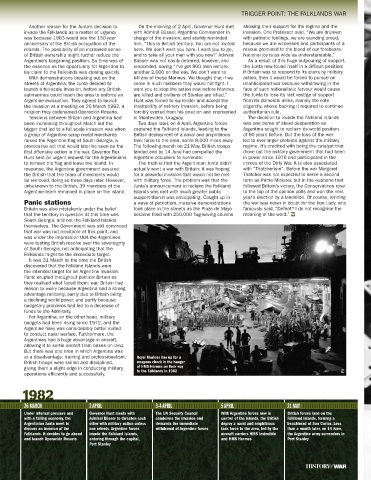
              at a disadvantage: training and professionalism.   Royal Marines line up for a
              British troops were skilled and disciplined,   weapons check in the hanger
              giving them a slight edge in conducting military   of HMS Hermes on their way
              operations efficiently and successfully.  to the Falklands in 1982                                               PA


             1982

              26 MARCH               2 APRIL                3-4 APRIL              5 APRIL                21 MAY
              Under internal pressure and   Governor Hunt meets with   The UN Security Council   With Argentine forces now in   British forces land on the
              with a failing economy, the   Admiral Büsser to threaten each   condemns the invasion and   control of the islands, the British   Falkland Islands, forming a
              Argentinian Junta meet to   other with military action unless   demands the immediate   deploy a naval and amphibious   beachhead at San Carlos. Less
              discuss an invasion of the   one relents. Argentine forces   withdrawal of Argentine forces  task force to the area, led by the   than a month later, on 14 June,
              Falklands. It decides to go ahead   invade the Falkland Islands,     aircraft carriers HMS Invincible   the Argentine army surrenders in
              and launch Operación Rosario  entering through the capital,          and HMS Hermes         Port Stanley
                                     Port Stanley


                                                                                                                 HISTORY  WAR
                                                                                                                         of

