


Page 137 - The Dinosaur Book and Other Wonders of the Prehistoric World (DK-Smithsonian)
P. 137
TINY SKULL


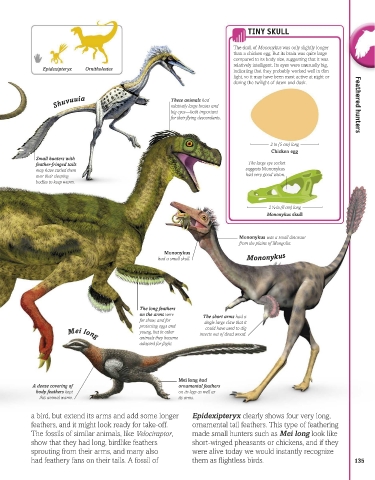
                                                                             The skull of Mononykus was only slightly longer
                                                                             than a chicken egg. But its brain was quite large
                                                                             compared to its body size, suggesting that it was
                                                                             relatively intelligent. Its eyes were unusually big,
               Epidexipteryx  Ornitholestes                                  indicating that they probably worked well in dim
                                                                             light, so it may have been most active at night or
                                                                             during the twilight of dawn and dusk.

                   Shuvuuia                              These animals had                                           Feathered hunters
                                                         relatively large brains and
                                                         big eyes—both important
                                                         for their flying descendants.


                                                                                         2 in (5 cm) long
                                                                                          Chicken egg
             Small hunters with
             feather-fringed tails                                                The large eye socket
             may have curled them                                                suggests Mononykus
             over their sleeping                                                 had very good vision.
             bodies to keep warm.


                                                                                         2  ⁄4 in (6 cm) long
                                                                                          1
                                                                                        Mononykus skull


                                                                               Mononykus was a small dinosaur
                                                                               from the plains of Mongolia.
                                                       Mononykus
                                                     had a small skull.           Mononykus


                                               The long feathers
                                               on the arms were    The short arms had a
                                               for show, and for    single large claw that it
                                               protecting eggs and   could have used to dig
                                               young, but in other
                       Mei long                                   insects out of dead wood.
                                               animals they became
                                               adapted for flight.


                                                           Mei long had
            A dense covering of                            ornamental feathers
             body feathers kept                            on its legs as well as
              this animal warm.                            its arms.


           a bird, but extend its arms and add some longer      Epidexipteryx clearly shows four very long,
           feathers, and it might look ready for take-off.      ornamental tail feathers. This type of feathering
           The fossils of similar animals, like Velociraptor,   made small hunters such as Mei long look like
           show that they had long, birdlike feathers           short-winged pheasants or chickens, and if they
           sprouting from their arms, and many also             were alive today we would instantly recognize
           had feathery fans on their tails. A fossil of        them as flightless birds.                            135


   US_134-135_Feathered_Hunters.indd   135                                                                       10/04/18   4:08 PM

