


Page 142 - The Dinosaur Book and Other Wonders of the Prehistoric World (DK-Smithsonian)
P. 142
Early birds


       Dinosaurs take flight  Iberomesornis  Hesperornis  Patagopteryx


                                                                                 Ichthyornis


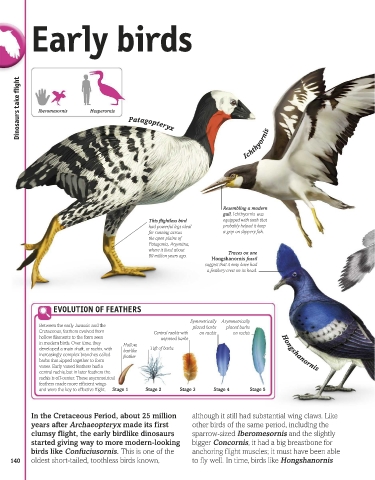
                                                                          Resembling a modern
                                                                          gull, Ichthyornis was
                                                  This flightless bird    equipped with teeth that
                                                  had powerful legs ideal   probably helped it keep
                                                  for running across      a grip on slippery fish.
                                                  the open plains of
                                                  Patagonia, Argentina,
                                                  where it lived about      Traces on one
                                                  80 million years ago.
                                                                      Hongshanornis fossil
                                                                    suggest that it may have had
                                                                     a feathery crest on its head.


                  EVOLUTION OF FEATHERS

                                                               Symmetrically  Asymmetrically
              Between the early Jurassic and the                placed barbs   placed barbs
              Cretaceous, feathers evolved from    Central rachis with   on rachis  on rachis
              hollow filaments to the form seen       unjoined barbs
              in modern birds. Over time, they   Hollow,
              developed a main shaft, or rachis, with   hairlike   Tuft of barbs             Hongshanornis
              increasingly complex branches called   feather
              barbs that zipped together to form
              vanes. Early vaned feathers had a
              central rachis, but in later feathers the
              rachis is off-center. These asymmetrical
              feathers made more efficient wings
              and were the key to effective flight.  Stage 1  Stage 2  Stage 3  Stage 4  Stage 5


           In the Cretaceous Period, about 25 million           although it still had substantial wing claws. Like
           years after Archaeopteryx made its first             other birds of the same period, including the
           clumsy flight, the early birdlike dinosaurs          sparrow-sized Iberomesornis and the slightly
           started giving way to more modern-looking            bigger Concornis, it had a big breastbone for
           birds like Confuciusornis. This is one of the        anchoring flight muscles; it must have been able
    140    oldest short-tailed, toothless birds known,          to fly well. In time, birds like Hongshanornis


   US_140-141_Early_birds.indd   140                                                                             10/04/18   3:34 PM

