


Page 14 - The Dinosaur Book and Other Wonders of the Prehistoric World (DK-Smithsonian)
P. 14
Types of


       Introduction  fossils


           Most of what we know about
           prehistoric life comes from fossils—

           the remains of ancient organisms
           entombed in rock. The study of
           fossils and the sedimentary rocks
           containing them has enabled
           scientists to piece together a
           record of life on Earth.


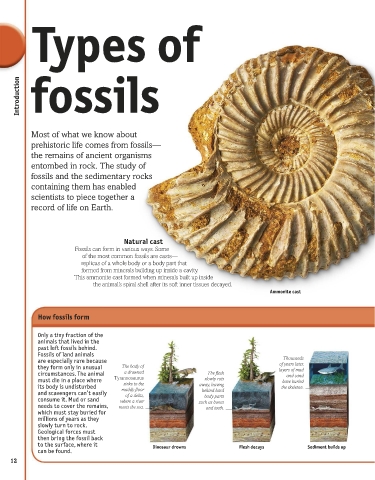
                                          Natural cast
                         Fossils can form in various ways. Some
                            of the most common fossils are casts—
                            replicas of a whole body or a body part that
                            formed from minerals building up inside a cavity.
                         This ammonite cast formed when minerals built up inside
                               the animal’s spiral shell after its soft inner tissues decayed.
                                                                                         Ammonite cast


             How fossils form


             Only a tiny fraction of the
             animals that lived in the
             past left fossils behind.
             Fossils of land animals
             are especially rare because                                                     Thousands
                                                                                            of years later,
             they form only in unusual   The body of                                        layers of mud
             circumstances. The animal    a drowned                  The flesh                 and sand
             must die in a place where   Tyrannosaurus              slowly rots              have buried
             its body is undisturbed     sinks to the             away, leaving              the skeleton.
             and scavengers can’t easily   muddy floor             behind hard
                                          of a delta,
             consume it. Mud or sand    where a river               body parts
             needs to cover the remains,   meets the sea.         such as bones
                                                                    and teeth.
             which must stay buried for
             millions of years as they
             slowly turn to rock.
             Geological forces must
             then bring the fossil back
             to the surface, where it              Dinosaur drowns             Flesh decays          Sediment builds up
             can be found.
    12


   US_012-013_Types_of_fossil.indd   12                                                                          10/04/18   3:32 PM

