


Page 10 - The Dinosaur Book and Other Wonders of the Prehistoric World (DK-Smithsonian)
P. 10
Timeline


       Introduction  of life


           The story of life on Earth is written in the rocks. Over millions of                      Early Earth KEY
           years, sediments like sand and clay settle on the floors of lakes                        Paleozoic Era
           and oceans and harden to form layer after layer of sedimentary
           rock. Trapped in these ancient deposits are the fossilized                               Mesozoic Era
           remains of prehistoric organisms, with each layer capturing                              Cenozoic Era

           a snapshot of life from a different period in history.                                Million years ago MYA


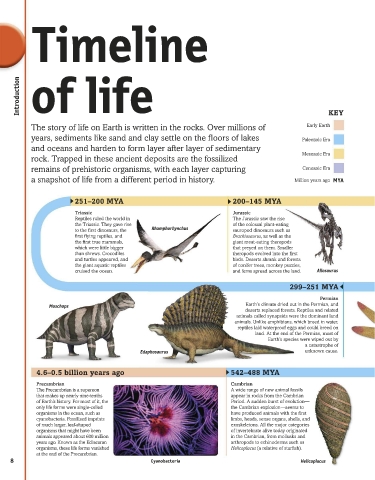
                         251–200 MYA                                         200–145 MYA

                         Triassic                                            Jurassic
                         Reptiles ruled the world in                         The Jurassic saw the rise
                         the Triassic. They gave rise                        of the colossal plant-eating
                         to the first dinosaurs, the   Rhamphorhynchus       sauropod dinosaurs such as
                         first flying reptiles, and                          Brachiosaurus, as well as the
                         the first true mammals,                             giant meat-eating theropods
                         which were little bigger                            that preyed on them. Smaller
                         than shrews. Crocodiles                             theropods evolved into the first
                         and turtles appeared, and                           birds. Deserts shrank and forests
                         the giant aquatic reptiles                          of conifer trees, monkey puzzles,
                         cruised the ocean.                                  and ferns spread across the land.  Allosaurus

                                                                                                299–251 MYA
                                                                                                          Permian
                 Moschops                                                        Earth’s climate dried out in the Permian, and
                                                                                 deserts replaced forests. Reptiles and related
                                                                              animals called synapsids were the dominant land
                                                                              animals. Unlike amphibians, which breed in water,
                                                                               reptiles laid waterproof eggs and could breed on
                                                                                    land. At the end of the Permian, most of
                                                                                         Earth’s species were wiped out by
                                                                                                     a catastrophe of
                                               Edaphosaurus                                          unknown cause.


             4.6–0.5 billion years ago                                      542–488 MYA

             Precambrian                                                    Cambrian
             The Precambrian is a supereon                                  A wide range of new animal fossils
             that makes up nearly nine-tenths                               appear in rocks from the Cambrian
             of Earth’s history. For most of it, the                        Period. A sudden burst of evolution—
             only life forms were single-celled                             the Cambrian explosion—seems to
             organisms in the ocean, such as                                have produced animals with the first
             cyanobacteria. Fossilized imprints                             limbs, heads, sense organs, shells, and
             of much larger, leaf-shaped                                    exoskeletons. All the major categories
             organisms that might have been                                 of invertebrate alive today originated
             animals appeared about 600 million                             in the Cambrian, from mollusks and
             years ago. Known as the Ediacaran                              arthropods to echinoderms such as
             organisms, these life forms vanished                           Helicoplacus (a relative of starfish).
             at the end of the Precambrian.
    8                                             Cyanobacteria                                    Helicoplacus


   US_008-009_Timeline_of_life.indd   8                                                                          23/04/18   6:16 PM

