


Page 15 - The Dinosaur Book and Other Wonders of the Prehistoric World (DK-Smithsonian)
P. 15
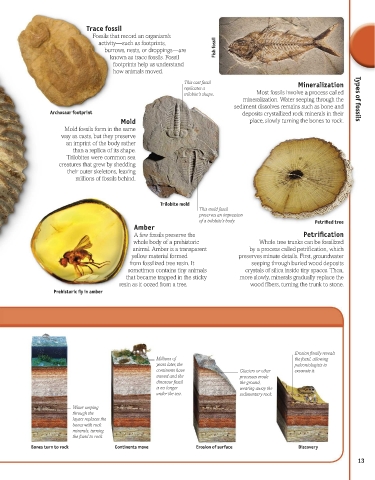
Trace fossil
                               Fossils that record an organism’s
                                 activity—such as footprints,
                                   burrows, nests, or droppings—are    Fish fossil
                                     known as trace fossils. Fossil
                                      footprints help us understand
                                      how animals moved.
                                                             This cast fossil                     Mineralization
                                                             replicates a
                                                             trilobite’s shape.      Most fossils involve a process called
                                                                                mineralization. Water seeping through the   Types of fossils
                                                                             sediment dissolves remains such as bone and
                 Archosaur footprint                                            deposits crystallized rock minerals in their
                                        Mold                                       place, slowly turning the bones to rock.
                      Mold fossils form in the same
                     way as casts, but they preserve
                       an imprint of the body rather
                         than a replica of its shape.
                       Trilobites were common sea
                    creatures that grew by shedding
                       their outer skeletons, leaving
                          millions of fossils behind.


                                                     Trilobite mold
                                                                  This mold fossil
                                                                  preserves an impression
                                                                  of a trilobite’s body.                Petrified tree
                                             Amber
                                             A few fossils preserve the                             Petrification
                                             whole body of a prehistoric              Whole tree trunks can be fossilized
                                            animal. Amber is a transparent         by a process called petrification, which
                                            yellow material formed             preserves minute details. First, groundwater
                                           from fossilized tree resin. It          seeping through buried wood deposits
                                           sometimes contains tiny animals       crystals of silica inside tiny spaces. Then,
                                          that became trapped in the sticky    more slowly, minerals gradually replace the
                                        resin as it oozed from a tree.             wood fibers, turning the trunk to stone.
                   Prehistoric fly in amber


                                                                                                 Erosion finally reveals
                                                    Millions of                                  the fossil, allowing
                                                    years later, the                             paleontologists to
                                                    continents have            Glaciers or other   excavate it.
                                                    moved and the              processes erode
                                                    dinosaur fossil            the ground,
                                                    is no longer               wearing away the
                                                    under the sea.             sedimentary rock.
                         Water seeping
                         through the
                         layers replaces the
                         bones with rock
                         minerals, turning
                         the fossil to rock.
           Bones turn to rock          Continents move           Erosion of surface                Discovery

                                                                                                                      13


   US_012-013_Types_of_fossil.indd   13                                                                          26/04/18   3:30 PM

