


Page 11 - The Dinosaur Book and Other Wonders of the Prehistoric World (DK-Smithsonian)
P. 11
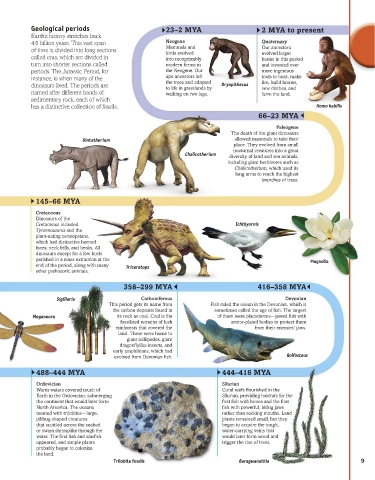
Geological periods                          23–2 MYA                       2 MYA to present
           Earth’s history stretches back
           4.6 billion years. This vast span           Neogene                        Quaternary
           of time is divided into long sections       Mammals and                    Our ancestors
           called eras, which are divided in           birds evolved                  evolved larger
                                                       into recognizably
                                                                                      brains in this period
           turn into shorter sections called           modern forms in                and invented ever
           periods. The Jurassic Period, for           the Neogene. Our               more ingenious
           instance, is when many of the               ape ancestors left             tools to hunt, make
           dinosaurs lived. The periods are            the trees and adapted   Dryopithecus  fire, build homes,
                                                       to life in grasslands by
                                                                                      sew clothes, and
           named after different bands of              walking on two legs.           farm the land.
           sedimentary rock, each of which
           has a distinctive collection of fossils.                                                     Homo habilis
                                                                                     66–23 MYA
                                                                                           Paleogene
                                                                            The death of the giant dinosaurs
                            Uintatherium                                      allowed mammals to take their
                                                                             place. They evolved from small
                                                                             nocturnal creatures into a great
                                                             Chalicotherium  diversity of land and sea animals,
                                                                           including giant herbivores such as
                                                                              Chalicotherium, which used its
                                                                              long arms to reach the highest
                                                                                       branches of trees.


             145–66 MYA

             Cretaceous
             Dinosaurs of the
             Cretaceous included                                              Ichthyornis
             Tyrannosaurus and the
             plant-eating ceratopsians,
             which had distinctive horned
             faces, neck frills, and beaks. All
             dinosaurs except for a few birds
             perished in a mass extinction at the                                                     Magnolia
             end of the period, along with many   Triceratops
             other prehistoric animals.

                                         358–299 MYA                                 416–358 MYA
                   Sigillaria                  Carboniferous                                  Devonian
                                     This period gets its name from   Fish ruled the ocean in the Devonian, which is
                                      the carbon deposits found in     sometimes called the age of fish. The largest
            Meganeura                  its rock as coal. Coal is the    of them were placoderms—jawed fish with
                                        fossilized remains of lush          armor-plated bodies to protect them
                                       rainforests that covered the                  from their enemies’ jaws.
                                        land. These were home to
                                          giant millipedes, giant
                                        dragonflylike insects, and
                                      early amphibians, which had
                                      evolved from Devonian fish.                              Rolfosteus

             488–444 MYA                                                  444–416 MYA

             Ordovician                                                   Silurian
             Warm waters covered much of                                  Coral reefs flourished in the
             Earth in the Ordovician, submerging                          Silurian, providing habitats for the
             the continent that would later form                          first fish with bones and the first
             North America. The oceans                                    fish with powerful, biting jaws
             teemed with trilobites—large,                                rather than sucking mouths. Land
             pillbug-shaped creatures                                     plants remained small, but they
             that scuttled across the seabed                              began to acquire the tough,
             or swam shrimplike through the                               water-carrying veins that
             water. The first fish and starfish                           would later form wood and
             appeared, and simple plants                                  trigger the rise of trees.
             probably began to colonize
             the land.
                                      Trilobite fossils                        Baragwanathia                           9


   US_008-009_Timeline_of_life.indd   9                                                                          23/04/18   6:16 PM

