


Page 151 - The Dinosaur Book and Other Wonders of the Prehistoric World (DK-Smithsonian)
P. 151
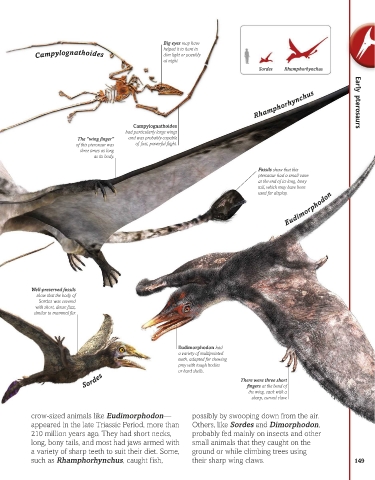
Big eyes may have
                                                      helped it to hunt in
             Campylognathoides                        dim light or possibly
                                                      at night.
                                                                                     Sordes   Rhamphorhynchus


                                                                                    Rhamphorhynchus                  Early  pterosaurs


                                             Campylognathoides
                                          had particularly large wings
                          The “wing finger”    and was probably capable
                          of this pterosaur was   of  fast, powerful flight.
                           three times as long
                                as its body.

                                                                                     Fossils show that this
                                                                                     pterosaur had a small vane
                                                                                     at the end of its long, bony
                                                                                     tail, which may have been
                                                                                              Eudimorphodon
                                                                                     used for display.


           Well-preserved fossils
             show that the body of
              Sordes was covered
             with short, dense fuzz,
            similar to mammal fur.


                                                           Eudimorphodon had
                                                           a variety of multipointed
                                                           teeth, adapted for chewing
                                                           prey with tough bodies
                                                           or hard shells.
                            Sordes                                              There were three short
                                                                                  fingers at the bend of
                                                                                  the wing, each with a
                                                                                   sharp, curved claw.


           crow-sized animals like Eudimorphodon—               possibly by swooping down from the air.
           appeared in the late Triassic Period, more than      Others, like Sordes and Dimorphodon,
           210 million years ago. They had short necks,         probably fed mainly on insects and other
           long, bony tails, and most had jaws armed with       small animals that they caught on the
           a variety of sharp teeth to suit their diet. Some,   ground or while climbing trees using
           such as Rhamphorhynchus, caught fish,                their sharp wing claws.                              149


   US_148-149_Early_Pterosaurs.indd   149                                                                        10/04/18   4:00 PM

