


Page 161 - The Dinosaur Book and Other Wonders of the Prehistoric World (DK-Smithsonian)
P. 161
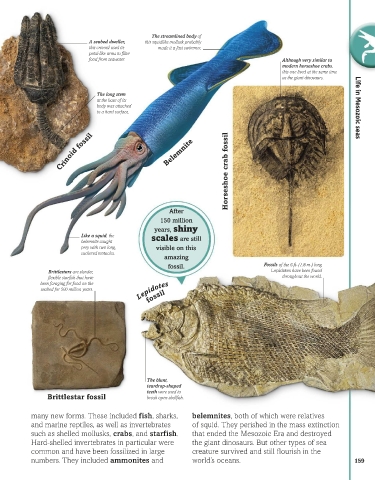
The streamlined body of
                              A seabed dweller,   this squidlike mollusk probably
                              this crinoid used its   made it a fast swimmer.
                              petal-like arms to filter
                              food from seawater.                                            Although very similar to
                                                                                             modern horseshoe crabs,
                                                                                             this one lived at the same time
                                                                                             as the giant dinosaurs.


                                 The long stem
                                 at the base of its
                                 body was attached                                                                   Life in Mesozoic seas
                                 to a hard surface.


                    Crinoid fossil                     Belemnite           Horseshoe crab fossil


                                                        After
                                                     150 million
                                                   years, shiny
                            Like a squid, the     scales are still
                            belemnite caught
                            prey with two long,     visible on this
                            suckered tentacles.
                                                       amazing
                                                        fossil.                        Fossils of the 6-ft- (1.8-m-) long
                 Brittlestars are slender,                                                Lepidotes have been found
                 flexible starfish that have                                                 throughout the world.
                                              Lepidotes
              been foraging for food on the
              seabed for 500 million years.
                                                 fossil


                                                 The blunt,
                                                 teardrop-shaped
                                                 teeth were used to
                 Brittlestar fossil              break open shellfish.


           many new forms. These included fish, sharks,         belemnites, both of which were relatives
           and marine reptiles, as well as invertebrates        of squid. They perished in the mass extinction
           such as shelled mollusks, crabs, and starfish.       that ended the Mesozoic Era and destroyed
           Hard-shelled invertebrates in particular were        the giant dinosaurs. But other types of sea
           common and have been fossilized in large             creature survived and still flourish in the
           numbers. They included ammonites and                 world’s oceans.                                      159


   US_158-159_Life_in_Mesozoic_seas.indd   159                                                                   12/07/18   3:46 PM

