


Page 117 - Complete Birds of Britain and Europe (DK - RSPB)
P. 117
WILDFOWL
       Order Anseriformes     Family Anatidae        Species Bucephala clangula
        Goldeneye                              green-glossed yellow eye  triangular
                                                                     dark
                                               black head with       bill
                                               bold white spot
                                  black marks on
                                  sparkling white body


                  large white
          MALE (WINTER)  belly
            extensive white
            on wing
                                                                MALE (WINTER)
                          body becomes
                          white with age
                                                  face develops white
                                                  spot in winter
                                                                 dark brown
                                                                 head
                                                      grey body
             FEMALE
            IN FLIGHT
                               JUVENILE (MALE)
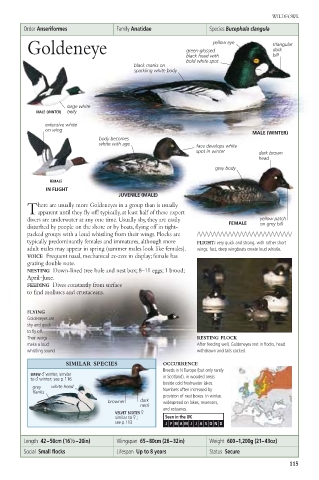
          here are usually more Goldeneyes in a group than is usually
        Tapparent until they fly off: typically, at least half of these expert
        divers are underwater at any one time. Usually shy, they are easily  FEMALE  yellow patch
        disturbed by people on the shore or by boats, flying off in tight-  on grey bill
        packed groups with a loud whistling from their wings. Flocks are
        typically predominantly females and immatures, although more   FLIGHT: very quick and strong, with rather short
        adult males may appear in spring (summer males look like females).  wings; fast, deep wingbeats create loud whistle.
        VOICE Frequent nasal, mechanical ze-zeee in display; female has
        grating double note.
        NESTING Down-lined tree hole and nest box; 8–11 eggs; 1 brood;
        April–June.
        FEEDING Dives constantly from surface
        to find molluscs and crustaceans.

        FLYING
        Goldeneyes are
        shy and quick
        to fly off.
        Their wings                               RESTING FLOCK
        make a loud                               After feeding well, Goldeneyes rest in flocks, head
        whistling sound.                          withdrawn and tails cocked.
                 SIMILAR SPECIES          OCCURRENCE
                                          Breeds in N Europe (but only rarely
         SMEW 3winter, similar            in Scotland), in wooded areas
         to 3winter; see p.116
                                          beside cold freshwater lakes.
         grey  white head                 Numbers often increased by
         flanks
                                          provision of nest boxes. In winter,
                            browner  dark  widespread on lakes, reservoirs,
                                    neck
                              VELVET SCOTER 2  and estuaries.
                              similar to 2;  Seen in the UK
                              see p.113   J  F  M  A  M  JJ A S O  N  D
       Length  42–50cm (16 1 ⁄2 –20in)  Wingspan  65–80cm (26–32in)  Weight  600–1,200g (21–43oz)
       Social  Small flocks   Lifespan  Up to 8 years  Status  Secure
                                                                         115

