


Page 116 - Complete Birds of Britain and Europe (DK - RSPB)
P. 116
WILDFOWL
       Order Anseriformes     Family Anatidae        Species Clangula hyemalis
        Long-tailed Duck                                smudgy white
                                                        band around eye

                               dark cheek patch
                     dark
                     wings
                                                    thick  JUVENILE (WINTER)
                                                    dark
                                                    bill
                                                            white
                                                            neck
                        pale flanks
            MALE (WINTER)
                                 FEMALE (WINTER)
                                             FEMALE
                                             (SUMMER)
                          long, flexible
                          tail point
                                                                    pink band
                                                   dark cheek
                                      white and pale  patch         on stubby
                                      grey body                     dark bill
        FEMALE (WINTER)
        IN FLIGHT
                       white
                rich   face
        white rear  brown  patch
        flanks  body
                                               MALE (WINTER)
                             MALE
                             (SUMMER)
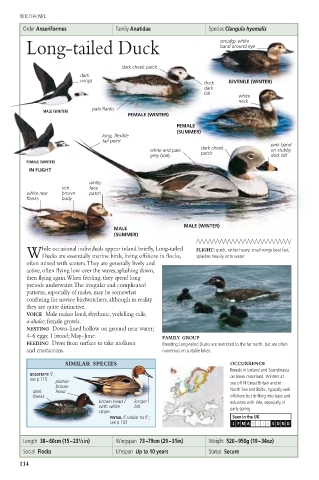
           hile occasional individuals appear inland briefly, Long-tailed  FLIGHT: quick, rather heavy; small wings beat fast;
        WDucks are essentially marine birds, living offshore in flocks,  splashes heavily onto water.
        often mixed with scoters.They are generally lively and
        active, often flying low over the waves,splashing down,
        then flying again.When feeding, they spend long
        periods underwater.The irregular and complicated
        patterns, especially of males, may be somewhat
        confusing for novice birdwatchers, although in reality
        they are quite distinctive.
        VOICE Male makes loud, rhythmic, yodelling calls,
        a-ahulee; female growls.
        NESTING Down-lined hollow on ground near water;
        4–6 eggs; 1 brood; May–June.     FAMILY GROUP
        FEEDING Dives from surface to take molluscs   Breeding Long-tailed Ducks are restricted to the far north, but are often
        and crustaceans.                 numerous on suitable lakes.
                 SIMILAR SPECIES                          OCCURRENCE
                                                          Breeds in Iceland and Scandinavia
        GOLDENEYE 2;                                      on bleak moorland. Winters at
        see p.115
               plainer                                    sea off N Great Britain and in
               brown
         dark  head                                       North Sea and Baltic, typically well
         flanks                                           offshore but drifting into bays and
                          brown head   longer             estuaries with tide, especially in
                          with white  bill                early spring.
                          stripe
                            PINTAIL 3similar to 3;         Seen in the UK
                            see p.103                      J  F  M  A  M  JJ A S O  N  D
       Length  38–60cm (15–23 1 ⁄2in)  Wingspan  73–79cm (29–31in)  Weight  520–950g (19–34oz)
       Social  Flocks         Lifespan  Up to 10 years  Status  Secure
      114

