


Page 132 - Complete Birds of Britain and Europe (DK - RSPB)
P. 132
BIRDS OF PREY
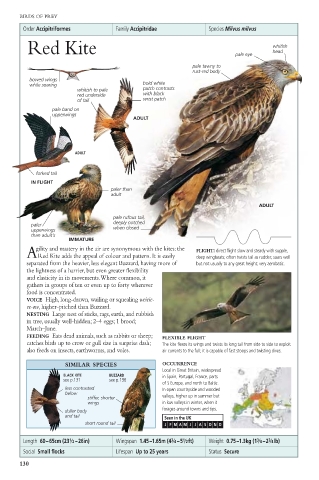
       Order Accipitriformes  Family Accipitridae    Species Milvus milvus
        Red Kite                                           pale eye  whitish
                                                                     head
                                                 pale tawny to
                                                 rust-red body
        bowed wings
        while soaring                bold white
                    whitish to pale  patch contrasts
                    red underside    with black
                    of tail          wrist patch
              pale band on
              upperwings
                                  ADULT


                    ADULT
          forked tail
         IN FLIGHT
                             paler than
                             adult
                                                                 ADULT
                             pale rufous tail,
                             deeply notched
         paler
         upperwings          when closed
         than adult’s
                  IMMATURE
          gility and mastery in the air are synonymous with the kites: the  FLIGHT: direct flight slow and steady with supple,
        ARed Kite adds the appeal of colour and pattern. It is easily  deep wingbeats; often twists tail as rudder; soars well
        separated from the heavier, less elegant Buzzard, having more of  but not usually to any great height; very aerobatic.
        the lightness of a harrier, but even greater flexibility
        and elasticity in its movements.Where common, it
        gathers in groups of ten or even up to forty wherever
        food is concentrated.
        VOICE High, long-drawn, wailing or squealing weieie-
        ee-ow, higher-pitched than Buzzard.
        NESTING Large nest of sticks, rags, earth, and rubbish
        in tree, usually well-hidden; 2–4 eggs; 1 brood;
        March–June.
        FEEDING Eats dead animals, such as rabbits or sheep;  FLEXIBLE FLIGHT
        catches birds up to crow or gull size in surprise dash;  The kite flexes its wings and twists its long tail from side to side to exploit
        also feeds on insects, earthworms, and voles.  air currents to the full; it is capable of fast stoops and twisting dives.
                 SIMILAR SPECIES         OCCURRENCE
                                         Local in Great Britain, widespread
                 BLACK KITE  BUZZARD     in Spain, Portugal, France, parts
                 see p.131  see p.136
                                         of S Europe, and north to Baltic.
                 less contrasted         In open countryside and wooded
                 below                   valleys, higher up in summer but
                       stiffer, shorter
                       wings             in low valleys in winter, when it
                                         forages around towns and tips.
                 duller body
                 and tail                 Seen in the UK
                      short round tail    J  F  M  A  M  JJ A S O  N  D
       Length  60–65cm (23 1 ⁄2 –26in)  Wingspan  1.45–1.65m (4 3 ⁄4 –5 1 ⁄2ft)  Weight  0.75–1.3kg (1 3 ⁄4 –2 3 ⁄4lb)
       Social  Small flocks   Lifespan  Up to 25 years  Status  Secure
      130

