


Page 135 - Complete Birds of Britain and Europe (DK - RSPB)
P. 135
BIRDS OF PREY
       Order Accipitriformes  Family Accipitridae    Species Circus cyaneus
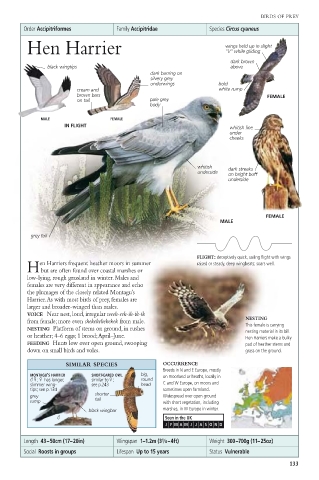
        Hen Harrier                                      wings held up in slight
                                                         “V” while gliding
                                                          dark brown
             black wingtips                               above
                                      dark barring on
                                      silvery grey
                                      underwings       bold
                    cream and                          white rump
                    brown bars                                     FEMALE
                    on tail           pale grey
                                      body
           MALE             FEMALE
                 IN FLIGHT                                whitish line
                                                          under
                                                          cheeks


                                                  whitish  dark streaks
                                                  underside
                                                          on bright buff
                                                          underside


                                                                   FEMALE
                                                        MALE
         grey tail


                                                  FLIGHT: deceptively quick, sailing flight with wings
           en Harriers frequent heather moors in summer  raised or steady, deep wingbeats; soars well.
        H but are often found over coastal marshes or
        low-lying, rough grassland in winter. Males and
        females are very different in appearance and echo
        the plumages of the closely related Montagu’s
        Harrier.As with most birds of prey, females are
        larger and broader-winged than males.
        VOICE Near nest, loud, irregular week-eek-ik-ik-ik
        from female; more even chekekekekekek from male.      NESTING
                                                              This female is carrying
        NESTING Platform of stems on ground, in rushes        nesting material in its bill.
        or heather; 4–6 eggs; 1 brood;April–June.             Hen Harriers make a bulky
        FEEDING Hunts low over open ground, swooping          pad of heather stems and
        down on small birds and voles.                        grass on the ground.
                 SIMILAR SPECIES          OCCURRENCE
                                          Breeds in N and E Europe, mostly
         MONTAGU’S HARRIER  SHORT-EARED OWL  big,  on moorland or heaths, locally in
         32; 2 has longer,  similar to 2;   round
         slimmer wing-  see p.243   head  C and W Europe, on moors and
         tips; see p.134                  sometimes open farmland.
                         shorter
        grey             tail             Widespread over open ground
        rump                              with short vegetation, including
                       black wingbar      marshes, in W Europe in winter.
               3                          Seen in the UK
                                          J  F  M  A  M  JJ A S O  N  D
       Length  43–50cm (17–20in)  Wingspan  1–1.2m (3 1 ⁄4 –4ft)  Weight  300–700g (11–25oz)
       Social  Roosts in groups  Lifespan  Up to 15 years  Status  Vulnerable
                                                                         133

