


Page 133 - Complete Birds of Britain and Europe (DK - RSPB)
P. 133
BIRDS OF PREY
       Order Accipitriformes  Family Accipitridae    Species Milvus migrans
        Black Kite


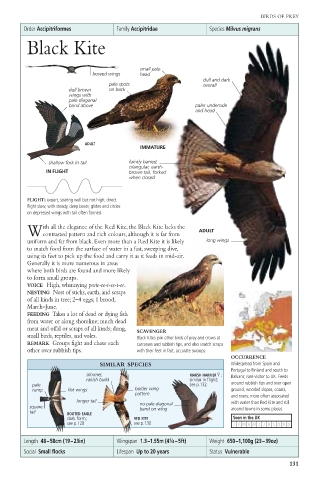
                                    small pale
                        bowed wings  head
                                                   dull and dark
                            pale spots             overall
                  dull brown  on back
                  wings with
                  pale diagonal
                  band above                      paler underside
                                                  and head


                      ADULT
                                    IMMATURE
             shallow fork in tail  faintly barred,
                                 triangular, earth-
             IN FLIGHT           brown tail, forked
                                 when closed

        FLIGHT: expert, soaring well but not high; direct
        flight slow, with steady, deep beats; glides and circles
        on depressed wings with tail often fanned.
            ith all the elegance of the Red Kite, the Black Kite lacks the  ADULT
        Wcontrasted pattern and rich colours, although it is far from
        uniform and far from black. Even more than a Red Kite it is likely  long wings
        to snatch food from the surface of water in a fast, sweeping dive,
        using its feet to pick up the food and carry it as it feeds in mid-air.
        Generally it is more numerous in areas
        where both birds are found and more likely
        to form small groups.
        VOICE High, whinnying peeie-ee-i-ee-i-ee.
        NESTING Nest of sticks, earth, and scraps
        of all kinds in tree; 2–4 eggs; 1 brood;
        March–June.
        FEEDING Takes a lot of dead or dying fish
        from water or along shoreline; much dead
        meat and offal or scraps of all kinds; dung,  SCAVENGER
        small birds, reptiles, and voles.  Black Kites join other birds of prey and crows at
        REMARK Groups fight and chase each  carcasses and rubbish tips, and also snatch scraps
        other over rubbish tips.   with their feet in fast, accurate swoops.
                                                          OCCURRENCE
                          SIMILAR SPECIES                 Widespread from Spain and
                                                          Portugal to Finland and south to
                      slimmer,                  MARSH HARRIER 2;  Balkans; rare visitor to UK. Feeds
                      rakish build              similar in flight;
         pale                                   see p.132  around rubbish tips and over open
         rump     flat wings       bolder wing            ground, wooded slopes, coasts,
                                   pattern
                                                          and rivers; more often associated
                    longer tail                           with water than Red Kite and still
        square                      no pale diagonal      around towns in some places.
                                    band on wing
        tail
                  BOOTED EAGLE
                  dark form;      RED KITE                 Seen in the UK
                  see p.128       see p.130                JF M A  M J  JA S ON D
       Length  48–58cm (19–23in)  Wingspan  1.3–1.55m (4 1 ⁄4 –5ft)  Weight  650–1,100g (23–39oz)
       Social  Small flocks   Lifespan  Up to 20 years  Status  Vulnerable
                                                                         131

