


Page 134 - Complete Birds of Britain and Europe (DK - RSPB)
P. 134
BIRDS OF PREY
       Order Accipitriformes  Family Accipitridae    Species Circus aeruginosus
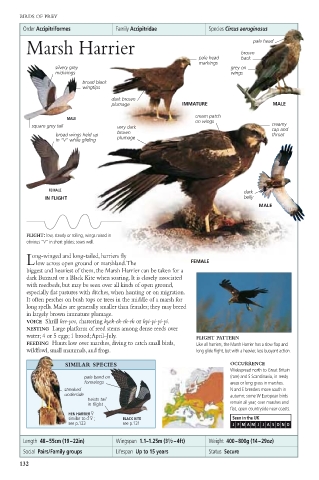
        Marsh Harrier                                           pale head

                                                  pale head  brown
                                                             back
                                                  markings
               silvery grey                               grey on
               midwings                                   wings
                      broad black
                      wingtips
                             dark brown
                             plumage          IMMATURE               MALE
                                                  cream patch
                  MALE
                                                  on wings
         square grey tail     very dark                              creamy
                                                                     cap and
               broad wings held up  brown                            throat
               in “V” while gliding  plumage


             FEMALE
                                                              dark
            IN FLIGHT                                         belly
                                                                 MALE


        FLIGHT: low, steady or rolling, wings raised in
        obvious “V” in short glides; soars well.
         ong-winged and long-tailed, harriers fly
        Llow across open ground or marshland.The  FEMALE
        biggest and heaviest of them, the Marsh Harrier can be taken for a
        dark Buzzard or a Black Kite when soaring. It is closely associated
        with reedbeds, but may be seen over all kinds of open ground,
        especially flat pastures with ditches, when hunting or on migration.
        It often perches on bush tops or trees in the middle of a marsh for
        long spells. Males are generally smaller than females; they may breed
        in largely brown immature plumage.
        VOICE Shrill kee-yoo, chattering kyek-ek-ek-ek or kyi-yi-yi-yi.
        NESTING Large platform of reed stems among dense reeds over
        water; 4 or 5 eggs; 1 brood;April–July.   FLIGHT PATTERN
        FEEDING Hunts low over marshes, diving to catch small birds,  Like all harriers, the Marsh Harrier has a slow flap and
        wildfowl, small mammals, and frogs.       long glide flight, but with a heavier, less buoyant action.
                 SIMILAR SPECIES                          OCCURRENCE
                                                          Widespread north to Great Britain
                      pale band on                        (rare) and S Scandinavia, in reedy
                      forewings                           areas or long grass in marshes.
                 streaked                                 N and E breeders move south in
                 underside                                autumn; some W European birds
                       twists tail
                       in flight                          remain all year, over marshes and
                                                          flat, open countryside near coasts.
                  HEN HARRIER 2
                  similar to 32;   BLACK KITE              Seen in the UK
                  see p.133     see p.131                  J  F  M  A  M  JJ A S O  N  D
       Length  48–55cm (19–22in)  Wingspan  1.1–1.25m (3 1 ⁄2 –4ft)  Weight  400–800g (14–29oz)
       Social  Pairs/Family groups  Lifespan  Up to 15 years  Status  Secure
      132

