


Page 225 - Complete Birds of Britain and Europe (DK - RSPB)
P. 225
SKUAS, GULLS,AND TERNS
       Order Charadriiformes  Family Sternidae       Species Sterna caspia
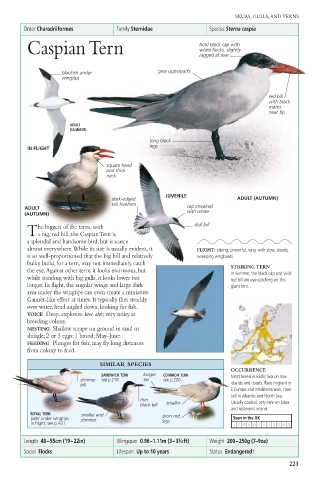
        Caspian Tern                               bold black cap with
                                                   white flecks, slightly
                                                   ragged at rear

                blackish under          grey upperparts
                wingtips

                                                                    red bill
                                                                    with black
                                                                    marks
                                                                    near tip
                  ADULT
                  (SUMMER)
                                      long black
                                      legs
        IN FLIGHT
                           square head
                           and thick
                           neck

                                          JUVENILE
                             dark-edged                     ADULT (AUTUMN)
                             tail feathers
       ADULT                                   cap streaked
       (AUTUMN)                                with white
          he biggest of the terns, with          dull bill
        Ta big, red bill, the Caspian Tern is
        a splendid and handsome bird, but is scarce
        almost everywhere.While its size is usually evident, it  FLIGHT: strong, powerful, easy, with slow, steady,
        is so well-proportioned that the big bill and relatively  sweeping wingbeats.
        bulky build, for a tern, may not immediately catch  STRIKING TERN
        the eye.Against other terns it looks enormous, but  In summer, the black cap and vivid
        while standing with big gulls, it looks lower but  red bill are eye-catching on this
        longer. In flight, the angular wings and large dark  giant tern.
        area under the wingtips can even create a miniature
        Gannet-like effect at times. It typically flies steadily
        over water, head angled down, looking for fish.
        VOICE Deep, explosive kree-ahk; very noisy at
        breeding colony.
        NESTING Shallow scrape on ground in sand or
        shingle; 2 or 3 eggs; 1 brood; May–June.
        FEEDING Plunges for fish; may fly long distances
        from colony to feed.
                          SIMILAR SPECIES
                                                          OCCURRENCE
                          SANDWICH TERN  longer  COMMON TERN  Most breed in Baltic Sea on low
                     slimmer  see p.218  tail  see p.220
                     bill                                 islands and coasts. Rare migrant in
                                                          E Europe and Mediterranean, rarer
                                                          still in Atlantic and North Sea.
                                    thin                  Usually coastal, very rare on lakes
                                    black bill  smaller
                                                          and reservoirs inland.
         ROYAL TERN  smaller and         short red
         paler under wingtips  slimmer                     Seen in the UK
         in flight; see p.431            legs              JF M A  M J  JA S ON D
       Length  48–55cm (19–22in)  Wingspan  0.96–1.11m (3–3 3 ⁄4ft)  Weight  200–250g (7–9oz)
       Social  Flocks         Lifespan  Up to 10 years  Status  Endangered†
                                                                         223

