


Page 228 - Complete Birds of Britain and Europe (DK - RSPB)
P. 228
SKUAS, GULLS,AND TERNS
       Order Charadriiformes  Family Alcidae         Species Alle alle
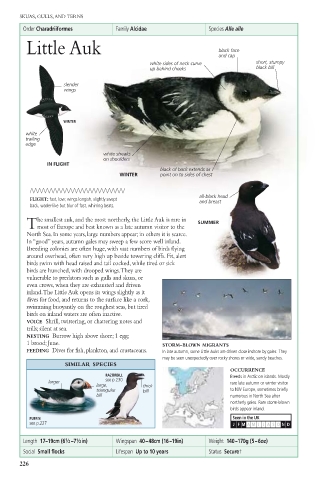
        Little Auk                                     black face
                                                       and cap
                                      white sides of neck curve  short, stumpy
                                      up behind cheeks           black bill
                 slender
                 wings


                 WINTER
       white
       trailing
       edge
                           white streaks
                           on shoulders
             IN FLIGHT
                                         black of back extends as
                               WINTER    point on to sides of chest
                                                   all-black head
        FLIGHT: fast, low; wings longish, slightly swept  and breast
        back, wader-like but blur of fast, whirring beats.
          he smallest auk, and the most northerly, the Little Auk is rare in  SUMMER
        Tmost of Europe and best known as a late autumn visitor to the
        North Sea.In some years,large numbers appear; in others it is scarce.
        In “good” years, autumn gales may sweep a few score well inland.
        Breeding colonies are often huge, with vast numbers of birds flying
        around overhead, often very high up beside towering cliffs. Fit, alert
        birds swim with head raised and tail cocked, while tired or sick
        birds are hunched, with drooped wings.They are
        vulnerable to predators such as gulls and skuas, or
        even crows, when they are exhausted and driven
        inland.The Little Auk opens its wings slightly as it
        dives for food, and returns to the surface like a cork,
        swimming buoyantly on the roughest seas, but tired
        birds on inland waters are often inactive.
        VOICE Shrill, twittering, or chattering notes and
        trills; silent at sea.
        NESTING Burrow high above shore; 1 egg;
        1 brood; June.                   STORM-BLOWN MIGRANTS
        FEEDING Dives for fish, plankton, and crustaceans.  In late autumn, some Little Auks are driven close inshore by gales. They
                                         may be seen unexpectedly over rocky shores or wide, sandy beaches.
                 SIMILAR SPECIES
                                                          OCCURRENCE
                           RAZORBILL                      Breeds in Arctic on islands. Mostly
                           see p.230
             larger                                       rare late autumn or winter visitor
                         large,      thick
                         triangular  bill                 to NW Europe, sometimes briefly
                         bill                             numerous in North Sea after
                                                          northerly gales. Rare storm-blown
                                                          birds appear inland.
        PUFFIN                                             Seen in the UK
        see p.227                                          J  F  M  A  M  JJ A S O  N  D
       Length  17–19cm (6 1 ⁄2 –7 1 ⁄2in)  Wingspan  40–48cm (16–19in)  Weight  140–170g (5–6oz)
       Social  Small flocks   Lifespan  Up to 10 years  Status  Secure†
      226

