


Page 221 - Complete Birds of Britain and Europe (DK - RSPB)
P. 221
SKUAS, GULLS,AND TERNS
       Order Charadriiformes  Family Sternidae       Species Sterna nilotica
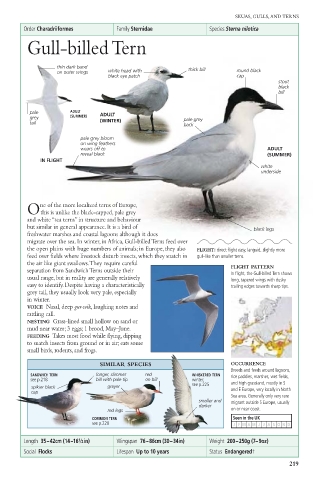
        Gull-billed Tern


               thin dark band
               on outer wings  white head with  thick bill  round black
                            black eye patch                 cap
                                                                      stout
                                                                      black
                                                                      bill
        pale      ADULT   ADULT
        grey      (SUMMER)                     pale grey
        tail              (WINTER)
                                               back
                     pale grey bloom
                     on wing feathers
                     wears off to                                  ADULT
                     reveal black                                  (SUMMER)
           IN FLIGHT
                                                                  white
                                                                  underside


           ne of the more localized terns of Europe,
        Othis is unlike the black-capped, pale grey
        and white “sea terns” in structure and behaviour
        but similar in general appearance. It is a bird of      black legs
        freshwater marshes and coastal lagoons although it does
        migrate over the sea. In winter, in Africa, Gull-billed Terns feed over
        the open plains with huge numbers of animals; in Europe, they also  FLIGHT: direct flight easy, languid, slightly more
        feed over fields where livestock disturb insects, which they snatch in  gull-like than smaller terns.
        the air like giant swallows.They require careful  FLIGHT PATTERN
        separation from Sandwich Terns outside their      In flight, the Gull-billed Tern shows
        usual range, but in reality are generally relatively  long, tapered wings with dusky
        easy to identify. Despite having a characteristically  trailing edges towards sharp tips.
        grey tail, they usually look very pale, especially
        in winter.
        VOICE Nasal, deep gur-wik, laughing notes and
        rattling call.
        NESTING Grass-lined small hollow on sand or
        mud near water; 3 eggs; 1 brood, May–June.
        FEEDING Takes most food while flying, dipping
        to snatch insects from ground or in air; eats some
        small birds, rodents, and frogs.
                          SIMILAR SPECIES                 OCCURRENCE
                                                          Breeds and feeds around lagoons,
         SANDWICH TERN   longer, slimmer  red    WHISKERED TERN  rice paddies, marshes, wet fields,
         see p.218       bill with pale tip  on bill  winter;
                                                 see p.225  and high grassland, mostly in S
         spikier black      greyer                        and E Europe, very locally in North
         cap
                                                          Sea area. Generally only very rare
                                                  smaller and  migrant outside S Europe, usually
                                                  darker
                            red legs                      on or near coast.
                        COMMON TERN                        Seen in the UK
                        see p.220                          JF M A  M J  JA S ON D
       Length  35–42cm (14–16 1 ⁄2in)  Wingspan  76–86cm (30–34in)  Weight  200–250g (7–9oz)
       Social  Flocks         Lifespan  Up to 10 years  Status  Endangered†
                                                                         219

