


Page 223 - Complete Birds of Britain and Europe (DK - RSPB)
P. 223
SKUAS, GULLS,AND TERNS
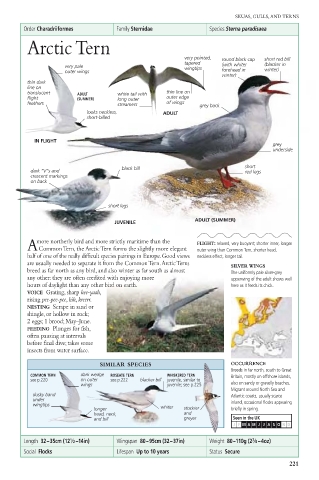
       Order Charadriiformes  Family Sternidae       Species Sterna paradisaea
        Arctic Tern

                                               very pointed,  round black cap  short red bill
                                               tapered             (blacker in
                 very pale                     wingtips  (with whiter
                 outer wings                            forehead in  winter)
                                                        winter)
        thin dark
        line on
        translucent  ADULT    white tail with  thin line on
        flight      (SUMMER)  long outer  outer edge
        feathers              streamers   of wings  grey back
                       looks neckless,   ADULT
                       short-billed
          IN FLIGHT
                                                                     grey
                                                                     underside
                               black bill                     short
         dark “V”s and                                        red legs
         crescent markings
         on back

                            short legs
                                                 ADULT (SUMMER)
                             JUVENILE
          more northerly bird and more strictly maritime than the   FLIGHT: relaxed, very buoyant; shorter inner, longer
        A Common Tern, the Arctic Tern forms the slightly more elegant  outer wing than Common Tern, shorter head,
        half of one of the really difficult species pairings in Europe.Good views  neckless effect, longer tail.
        are usually needed to separate it from the Common Tern.Arctic Terns  SILVER WINGS
        breed as far north as any bird, and also winter as far south as almost  The uniformly pale silver-grey
        any other: they are often credited with enjoying more  upperwing of the adult shows well
        hours of daylight than any other bird on earth.   here as it feeds its chick.
        VOICE Grating, sharp kee-yaah,
        rising pee-pee-pee, kik, kreerr.
        NESTING Scrape in sand or
        shingle, or hollow in rock;
        2 eggs; 1 brood; May–June.
        FEEDING Plunges for fish,
        often pausing at intervals
        before final dive; takes some
        insects from water surface.
                          SIMILAR SPECIES                 OCCURRENCE
                                                          Breeds in far north, south to Great
         COMMON TERN  dark wedge  ROSEATE TERN  WHISKERED TERN  Britain, mostly on offshore islands,
         see p.220   on outer  see p.222  blacker bill  juvenile, similar to
                     wings                juvenile; see p.225  also on sandy or gravelly beaches.
                                                          Migrant around North Sea and
         dusky band                                       Atlantic coasts, usually scarce
         under                                            inland, occasional flocks appearing
         wingtips                        whiter
                        longer                 stockier   briefly in spring.
                        head, neck,            and
                        and bill               greyer      Seen in the UK
                                                           J  F  M  A  M  JJ A S O  N  D
       Length  32–35cm (12 1 ⁄2 –14in)  Wingspan  80–95cm (32–37in)  Weight  80–110g (2 7 ⁄8 –4oz)
       Social  Flocks         Lifespan  Up to 10 years  Status  Secure
                                                                         221

