


Page 318 - Complete Birds of Britain and Europe (DK - RSPB)
P. 318
WARBLERS AND ALLIES
       Order Passeriformes    Family Sylviidae       Species Sylvia atricapilla
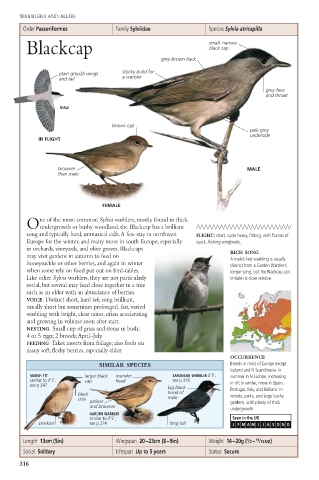
        Blackcap                                     small, narrow
                                                     black cap
                                         grey-brown back
                               stocky build for
                plain greyish wings
                and tail       a warbler
                                                                   grey face
                                                                   and throat
                MALE

                             brown cap
                                                               pale grey
                                                               underside
           IN FLIGHT


               browner                                        MALE
               than male


                          FEMALE
           ne of the more common Sylvia warblers, mostly found in thick
        Oundergrowth or bushy woodland, the Blackcap has a brilliant
        song and typically hard, unmusical calls.A few stay in northwest  FLIGHT: short, quite heavy, flitting, with flurries of
        Europe for the winter, and many more in south Europe, especially   quick, flicking wingbeats.
        in orchards, vineyards, and olive groves. Blackcaps   RICH SONG
        may visit gardens in autumn to feed on            A male’s fast warbling is usually
        honeysuckle or other berries, and again in winter  distinct from a Garden Warbler’s
        when some rely on food put out on bird-tables.    longer song, but the Blackcap can
        Like other Sylvia warblers, they are not particularly  imitate its close relative.
        social, but several may feed close together in a tree
        such as an elder with an abundance of berries.
        VOICE Distinct short, hard tak; song brilliant,
        usually short but sometimes prolonged, fast, varied
        warbling with bright, clear notes, often accelerating
        and growing in volume soon after start.
        NESTING Small cup of grass and stems in bush;
        4 or 5 eggs; 2 broods;April–July.
        FEEDING Takes insects from foliage; also feeds on
        many soft, fleshy berries, especially elder.
                                                          OCCURRENCE
                          SIMILAR SPECIES                 Breeds in most of Europe except
                                                          Iceland and N Scandinavia. In
        MARSH TIT     larger black  rounder  SARDINIAN WARBLER 32;  summer in N Europe; increasing
        similar to 32;   cap  head          see p.318     in UK in winter, more in Spain,
        see p.347
                                           big black      Portugal, Italy, and Balkans. In
                    black                  hood of        woods, parks, and large bushy
                    chin  plainer          male           gardens, with plenty of thick
                       and browner
                                                          undergrowth.
                       GARDEN WARBLER
                       similar to 32;                      Seen in the UK
           stockier    see p.314           long tail       J  F  M  A  M  JJ A S O  N  D
       Length  13cm (5in)     Wingspan  20–23cm (8–9in)  Weight  14–20g ( 1 ⁄2 – 11 ⁄16oz)
       Social  Solitary       Lifespan  Up to 5 years  Status  Secure
      316

