


Page 315 - Complete Birds of Britain and Europe (DK - RSPB)
P. 315
WARBLERS AND ALLIES/FLYCATCHERS
        Family Sylviidae
        WARBLERS AND ALLIES

            OSTLY SMALLER THAN the thrushes and  short bills, often peaked heads, and slim,
        M chats, most warblers fall into several neat  sometimes cocked tails; some have brightly
        groups, best recognized by their generic names.  coloured eye-rings. Their calls are short and hard
         Locustella warblers have grasshopper- or cricket- (“tak”) but their songs are often beautifully rich.
        like songs; they are hard to see and identify, and  Phylloscopus warblers are mostly
        have narrow heads, wings with curved outer  green and yellowish;
        edges, and long undertail coverts beneath a  they are delicate,
        rounded tail.                     slipping easily through
         Acrocephalus warblers are mostly reedbed birds,  foliage, have sweet
        with spiky bills, flattish heads, rather long tails,  “hooeet” calls, and
        and strong feet that give a grip on upright  distinctive songs.
        stems.Their songs are rich and hurried, often
        with repetitive patterns; calls are churring.
         Hippolais warblers are green or pale brown,with
        spike-like bills. Wing length is a vital clue to
        their identity. They have short undertail coverts
        and square tails, and hurried, rambling songs.
         Sylvia warblers are small, lively, perky birds with


                                      PERSISTENT
                                      SINGERS
                                      Male warblers sing a
                                      lot, especially if they
                                      are unable to find a
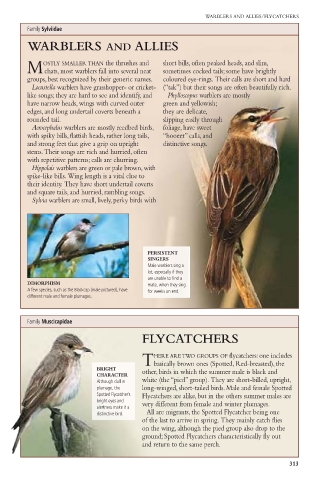
        DIMORPHISM                    mate, when they sing
        A few species, such as the Blackcap (male pictured), have  for weeks on end.
        different male and female plumages.

        Family Muscicapidae

                                    FLYCATCHERS

                                       HERE ARE TWO GROUPS OF flycatchers:one includes
                                    Tbasically brown ones (Spotted, Red-breasted), the
                         BRIGHT     other, birds in which the summer male is black and
                         CHARACTER
                         Although dull in  white (the “pied” group). They are short-billed, upright,
                         plumage, the  long-winged, short-tailed birds. Male and female Spotted
                         Spotted Flycatcher’s  Flycatchers are alike, but in the others summer males are
                         bright eyes and  very different from female and winter plumages.
                         alertness make it a
                         distinctive bird.  All are migrants, the Spotted Flycatcher being one
                                    of the last to arrive in spring. They mainly catch flies
                                    on the wing, although the pied group also drop to the
                                    ground; Spotted Flycatchers characteristically fly out
                                    and return to the same perch.


                                                                         313

