


Page 342 - Complete Birds of Britain and Europe (DK - RSPB)
P. 342
FLYCATCHERS
       Order Passeriformes    Family Muscicapidae    Species Ficedula hypoleuca
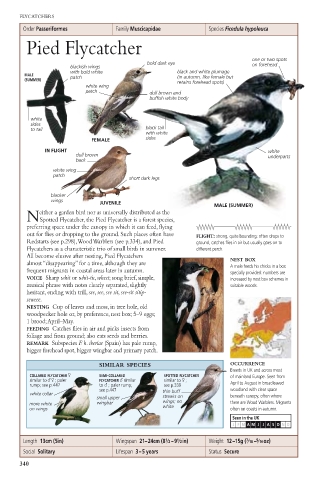
        Pied Flycatcher

                                                                one or two spots
                                      bold dark eye
                  blackish wings                                on forehead
                  with bold white            black and white plumage
       MALE       patch                      (in autumn, like female but
       (SUMMER)                              retains forehead spots)
                      white wing
                      patch           dull brown and
                                      buffish white body
         white
         sides
         to tail                     black tail
                                     with white
                        FEMALE       sides
            IN FLIGHT                                               white
                    dull brown                                      underparts
                    back
              white wing
              patch
                                 short dark legs
              blacker
              wings       JUVENILE
                                                      MALE (SUMMER)
           either a garden bird nor as universally distributed as the
        NSpotted Flycatcher, the Pied Flycatcher is a forest species,
        preferring space under the canopy in which it can feed, flying
        out for flies or dropping to the ground. Such places often have  FLIGHT: strong, quite bounding; often drops to
        Redstarts (see p.298),Wood Warblers (see p.334), and Pied  ground, catches flies in air but usually goes on to
        Flycatchers as a characteristic trio of small birds in summer.  different perch.
        All become elusive after nesting, Pied Flycatchers
        almost “disappearing” for a time, although they are  NEST BOX
                                                          A male feeds his chicks in a box
        frequent migrants in coastal areas later in autumn.  specially provided: numbers are
        VOICE Sharp whit or whit-tic, wheet; song brief, simple,  increased by nest box schemes in
        musical phrase with notes clearly separated, slightly  suitable woods.
        hesitant, ending with trill, see, see, see sit, see-sit sitip-
        seweee.
        NESTING Cup of leaves and moss, in tree hole, old
        woodpecker hole or, by preference, nest box; 5–9 eggs;
        1 brood;April–May.
        FEEDING Catches flies in air and picks insects from
        foliage and from ground; also eats seeds and berries.
        REMARK Subspecies F. h. iberiae (Spain) has pale rump,
        bigger forehead spot, bigger wingbar and primary patch.
                          SIMILAR SPECIES                 OCCURRENCE
                                                          Breeds in UK and across most
        COLLARED FLYCATCHER 2  SEMI-COLLARED  SPOTTED FLYCATCHER  of mainland Europe. Seen from
        similar to 32; paler  FLYCATCHER 3similar  similar to 2;   April to August in broadleaved
        rump; see p.447   to 3; paler rump;   see p.339
                          see p.447      thin buff        woodland with clear space
        white collar                                      beneath canopy, often where
                         small upper     streaks on
        more white       wingbar         wings; no        there are Wood Warblers. Migrants
                                         white
        on wings                                          often on coasts in autumn.
                                                           Seen in the UK
                                                           J  F  M  A  M  JJ A S O  N  D
       Length  13cm (5in)     Wingspan  21–24cm (8 1 ⁄2 –9 1 ⁄2in)  Weight  12–15g ( 7 ⁄16 – 9 ⁄16oz)
       Social  Solitary       Lifespan  3–5 years    Status  Secure
      340

