


Page 340 - Complete Birds of Britain and Europe (DK - RSPB)
P. 340
WARBLERS AND ALLIES
       Order Passeriformes    Family Sylviidae       Species Regulus ignicapillus
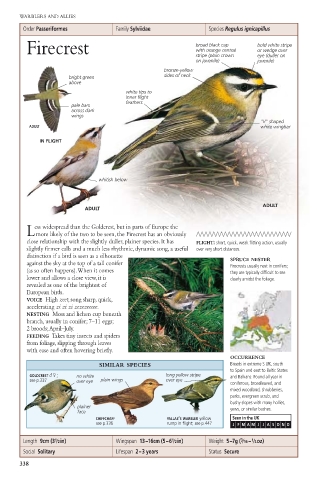
        Firecrest                                 broad black cap  bold white stripe
                                                  with orange central
                                                                 or wedge over
                                                  stripe (plain crown  eye (duller on
                                                  on juvenile)   juvenile)
                                          bronze-yellow
                  bright green            sides of neck
                  above
                                white tips to
                                inner flight
                                feathers
                   pale bars
                   across dark
                   wings
                                                                  “V” shaped
        ADULT                                                     white wingbar
           IN FLIGHT


                         whitish below


                                                                  ADULT
                      ADULT
          ess widespread than the Goldcrest, but in parts of Europe the
        Lmore likely of the two to be seen, the Firecrest has an obviously
        close relationship with the slightly duller, plainer species. It has  FLIGHT: short, quick, weak flitting action, usually
        slightly firmer calls and a much less rhythmic, dynamic song, a useful  over very short distances.
        distinction if a bird is seen as a silhouette     SPRUCE NESTER
        against the sky at the top of a tall conifer      Firecrests usually nest in conifers;
        (as so often happens).When it comes               they are typically difficult to see
        lower and allows a close view, it is              clearly amidst the foliage.
        revealed as one of the brightest of
        European birds.
        VOICE High zeet; song sharp, quick,
        accelerating zi zi zi zezezeeeee.
        NESTING Moss and lichen cup beneath
        branch, usually in conifer; 7–11 eggs;
        2 broods;April–July.
        FEEDING Takes tiny insects and spiders
        from foliage, slipping through leaves
        with ease and often hovering briefly.
                                                          OCCURRENCE
                          SIMILAR SPECIES                 Breeds in extreme S UK, south
                                                          to Spain and east to Baltic States
        GOLDCREST 32;  no white           long yellow stripe  and Balkans. Found all year in
        see p.337   over eye  plain wings  over eye
                                                          coniferous, broadleaved, and
                                                          mixed woodland, shrubberies,
                                                          parks, evergreen scrub, and
                                                          bushy slopes with many hollies,
                    plainer                               yews, or similar bushes.
                    face
                         CHIFFCHAFF       PALLAS’S WARBLER yellow  Seen in the UK
                         see p.336        rump in flight; see p.447  J  F  M  A  M  JJ A S O  N  D
       Length  9cm (3 1 ⁄2in)  Wingspan  13–16cm (5–6 1 ⁄2in)  Weight  5–7g ( 3 ⁄16 – 1 ⁄4oz)
       Social  Solitary       Lifespan  2–3 years    Status  Secure
      338

