


Page 346 - Complete Birds of Britain and Europe (DK - RSPB)
P. 346
TITS AND ALLIES
       Order Passeriformes    Family Paridae         Species Parus caeruleus
        Blue Tit                                           greenish cap

                                    bright blue cap,
                                    surrounded by
                                    white
        white bars on
        blue wings
                               dark line
                               through eye
                                                           dull yellow
                                                           underside
                          white cheeks
                                                            JUVENILE
           MALE
                                                    narrow
                                                    black chin
         IN FLIGHT
                                                           slightly less
                                                           blue than
                                                           male
                                                pale yellow
                                                underside with
                                                thin, dark
                                                central streak
         blue tail (brightest
         in spring male)
                              MALE                             FEMALE
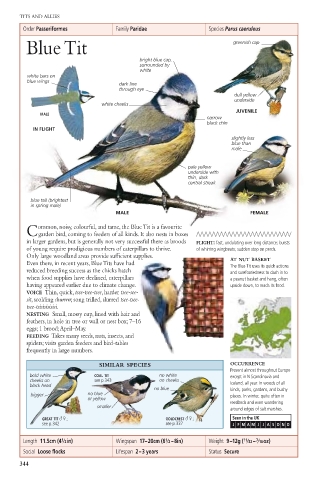
          ommon, noisy, colourful, and tame, the Blue Tit is a favourite
        Cgarden bird, coming to feeders of all kinds. It also nests in boxes
        in larger gardens, but is generally not very successful there as broods  FLIGHT: fast, undulating over long distance; bursts
        of young require prodigious numbers of caterpillars to thrive.  of whirring wingbeats; sudden stop on perch.
        Only large woodland areas provide sufficient supplies.  AT NUT BASKET
        Even there, in recent years, Blue Tits have had   The Blue Tit uses its quick actions
        reduced breeding success as the chicks hatch      and surefootedness to dash in to
        when food supplies have declined, caterpillars    a peanut basket and hang, often
        having appeared earlier due to climate change.    upside down, to reach its food.
        VOICE Thin, quick, tsee-tsee-tsee, harder tsee-see-
        sit, scolding churrrrr; song trilled, slurred tsee-tsee-
        tsee-tsisisisisisi.
        NESTING Small, mossy cup, lined with hair and
        feathers, in hole in tree or wall or nest box; 7–16
        eggs; 1 brood;April–May.
        FEEDING Takes many seeds, nuts, insects, and
        spiders; visits garden feeders and bird-tables
        frequently in large numbers.
                          SIMILAR SPECIES                 OCCURRENCE
                                                          Present almost throughout Europe
        bold white      COAL TIT         no white         except in N Scandinavia and
        cheeks on       see p.343        on cheeks        Iceland, all year. In woods of all
        black head
                                       no blue            kinds, parks, gardens, and bushy
         bigger        no blue                            places. In winter, quite often in
                       or yellow
                                                          reedbeds and even wandering
                         smaller
                                                          around edges of salt marshes.
           GREAT TIT 32;                  GOLDCREST 32;    Seen in the UK
           see p.342                      see p.337        J  F  M  A  M  JJ A S O  N  D
       Length  11.5cm (4 1 ⁄2in)  Wingspan  17–20cm (6 1 ⁄2 –8in)  Weight  9–12g ( 11 ⁄32 – 7 ⁄16oz)
       Social  Loose flocks   Lifespan  2–3 years    Status  Secure
      344

