


Page 338 - Complete Birds of Britain and Europe (DK - RSPB)
P. 338
WARBLERS AND ALLIES
       Order Passeriformes    Family Sylviidae       Species Phylloscopus collybita
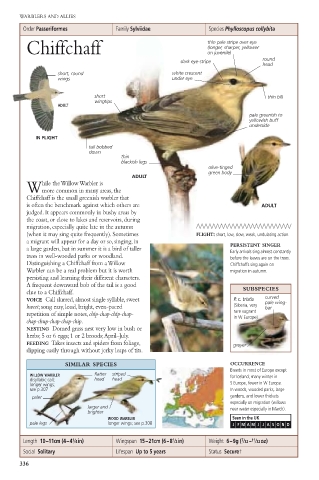
        Chiffchaff                                   thin pale stripe over eye
                                                     (longer, sharper, yellower
                                                     on juvenile)
                                                                  round
                                              dark eye-stripe
                                                                  head
               short, round                 white crescent
               wings                        under eye
                         short                                     thin bill
                         wingtips
               ADULT
                                                               pale greenish to
                                                               yellowish buff
                                                               underside
          IN FLIGHT
                       tail bobbed
                       down
                               thin
                               blackish legs
                                                     olive-tinged
                                                     green body
                                  ADULT
           hile the Willow Warbler is
        Wmore common in many areas, the
        Chiffchaff is the small greenish warbler that
        is often the benchmark against which others are           ADULT
        judged. It appears commonly in bushy areas by
        the coast, or close to lakes and reservoirs, during
        migration, especially quite late in the autumn
        (when it may sing quite frequently). Sometimes   FLIGHT: short, low, slow, weak, undulating action.
        a migrant will appear for a day or so, singing, in   PERSISTENT SINGER
        a large garden, but in summer it is a bird of taller  Early arrivals sing almost constantly
        trees in well-wooded parks or woodland.           before the leaves are on the trees.
        Distinguishing a Chiffchaff from a Willow         Chiffchaffs sing again on
        Warbler can be a real problem but it is worth     migration in autumn.
        persisting and learning their different characters.
        A frequent downward bob of the tail is a good        SUBSPECIES
        clue to a Chiffchaff.
        VOICE Call slurred, almost single syllable, sweet  P. c. tristis  curved
                                                                   pale wing-
        hweet; song easy, loud, bright, even-paced         (Siberia, very   bar
        repetition of simple notes, chip-chap-chip-chap-   rare vagrant
                                                           in W Europe)
        chap-chup-chap-chap-chip.
        NESTING Domed grass nest very low in bush or
        herbs; 5 or 6 eggs; 1 or 2 broods;April–July.
        FEEDING Takes insects and spiders from foliage,    greyer
        slipping easily through without jerky leaps of tits.
                 SIMILAR SPECIES                          OCCURRENCE
                                                          Breeds in most of Europe except
        WILLOW WARBLER  flatter  striped                  for Iceland; many winter in
        disyllabic call;  head  head
        longer wings;                                     S Europe, fewer in W Europe.
        see p.307                                         In woods, wooded parks, large
         paler                                            gardens, and lower thickets
                                                          especially on migration (willows
                       larger and                         near water especially in March).
                       brighter
                            WOOD WARBLER                   Seen in the UK
        pale legs           longer wings; see p.308        J  F  M  A  M  JJ A S O  N  D
       Length  10–11cm (4–4 1 ⁄4in)  Wingspan  15–21cm (6–8 1 ⁄2in)  Weight  6–9g ( 7 ⁄32 – 11 ⁄32oz)
       Social  Solitary       Lifespan  Up to 5 years  Status  Secure†
      336

