


Page 349 - Complete Birds of Britain and Europe (DK - RSPB)
P. 349
TITS AND ALLIES
       Order Passeriformes    Family Paridae         Species Parus palustris
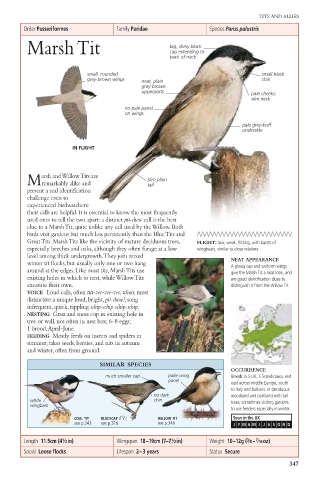
        Marsh Tit                          big, shiny black
                                           cap extending to
                                           back of neck
                       small, rounded                             small black
                       grey-brown wings  neat, plain              chin
                                    grey-brown
                                    upperparts
                                                               pale cheeks;
                                                               slim neck
                                no pale panel
                                on wings
                                                             pale grey-buff
                                                             underside

                   IN FLIGHT


           arsh and Willow Tits are   slim plain
        Mremarkably alike and         tail
        present a real identification
        challenge even to
        experienced birdwatchers:
        their calls are helpful. It is essential to know the most frequently
        used ones to tell the two apart: a distinct pit-chew call is the best
        clue to a Marsh Tit, quite unlike any call used by the Willow. Both
        birds visit gardens but much less persistently than the Blue Tits and
        Great Tits. Marsh Tits like the vicinity of mature deciduous trees,  FLIGHT: low, weak, flitting, with bursts of
        especially beeches and oaks, although they often forage at a low   wingbeats, similar to close relatives.
        level among thick undergrowth.They join mixed     NEAT APPEARANCE
        winter tit flocks, but usually only one or two hang  A glossy cap and uniform wings
        around at the edges. Like most tits, Marsh Tits use  give the Marsh Tit a neat look, and
        existing holes in which to nest, while Willow Tits  are good identification clues to
        excavate their own.                               distinguish it from the Willow Tit.
        VOICE Loud calls, often titi-zee-zee-zee, tchair, most
        distinctive a unique loud, bright, pit-chew!; song
        infrequent, quick, rippling schip-schip-schip-schip.
        NESTING Grass and moss cup in existing hole in
        tree or wall, not often in nest box; 6–8 eggs;
        1 brood;April–June.
        FEEDING Mostly feeds on insects and spiders in
        summer; takes seeds, berries, and nits in autumn
        and winter, often from ground.
                          SIMILAR SPECIES
                                                          OCCURRENCE
                           much smaller cap  paler wing   Breeds in S UK, S Scandinavia, and
                                           panel          east across middle Europe, south
                                                          to Italy and Balkans. In deciduous
                                       no dark            woodland and parkland with tall
        white                          chin               trees, sometimes visiting gardens
        wingbars
                                                          to use feeders especially in winter.
                   COAL TIT  BLACKCAP 32;  WILLOW TIT      Seen in the UK
                   see p.343  see p.316  see p.346         J  F  M  A  M  JJ A S O  N  D
       Length  11.5cm (4 1 ⁄2in)  Wingspan  18–19cm (7–7 1 ⁄2in)  Weight  10–12g ( 3 ⁄8 – 7 ⁄16oz)
       Social  Loose flocks   Lifespan  2–3 years    Status  Secure
                                                                         347

