


Page 365 - Complete Birds of Britain and Europe (DK - RSPB)
P. 365
CROWS
       Order Passeriformes    Family Corvidae        Species Pica pica
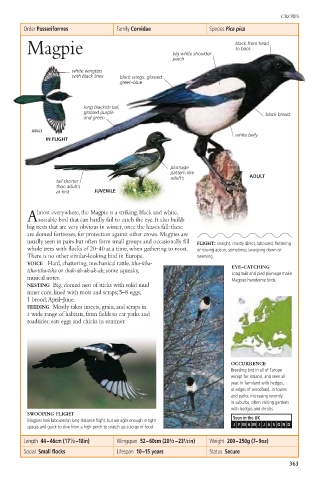
        Magpie                                             black from head
                                                           to back
                                            big white shoulder
                                            patch
                   white wingtips
                   with black lines  black wings, glossed
                               green-blue

                      long blackish tail,
                      glossed purple                               black breast
                      and green
         ADULT
                                                           white belly
            IN FLIGHT


                                           plumage
                                           pattern like
                                           adult’s             ADULT
               tail shorter
               than adult’s
               at first  JUVENILE
          lmost everywhere, the Magpie is a striking, black and white,
        Asociable bird that can hardly fail to catch the eye. It also builds
        big nests that are very obvious in winter, once the leaves fall: these
        are domed fortresses, for protection against other crows. Magpies are
        usually seen in pairs but often form small groups and occasionally fill  FLIGHT: straight, mostly direct, laboured; fluttering
        whole trees with flocks of 20–40 at a time, when gathering to roost.  or rowing action, sometimes swooping down or
        There is no other similar-looking bird in Europe.  swerving.
        VOICE Hard, chattering, mechanical rattle, tcha-tcha-
        tcha-tcha-tcha or chak-ak-ak-ak-ak; some squeaky,  EYE-CATCHING
                                                           Long tails and pied plumage make
        musical notes.                                     Magpies handsome birds.
        NESTING Big, domed nest of sticks with solid mud
        inner core, lined with roots and scraps; 5–8 eggs;
        1 brood;April–June.
        FEEDING Mostly takes insects, grain, and scraps in
        a wide range of habitats, from fields to car parks and
        roadsides; eats eggs and chicks in summer.


                                                          OCCURRENCE
                                                          Breeding bird in all of Europe
                                                          except for Iceland, and seen all
                                                          year. In farmland with hedges,
                                                          at edges of woodland, in towns
                                                          and parks; increasing recently
                                                          in suburbs, often visiting gardens
                                                          with hedges and shrubs.
        SWOOPING FLIGHT
        Magpies look laboured in long-distance flight, but are agile enough in tight  Seen in the UK
        spaces and quick to dive from a high perch to snatch up a scrap of food.  J  F  M  A  M  JJ A S O  N  D
       Length  44–46cm (17 1 ⁄2 –18in)  Wingspan  52–60cm (20 1 ⁄2 –23 1 ⁄2in)  Weight  200–250g (7–9oz)
       Social  Small flocks   Lifespan  10–15 years  Status  Secure
                                                                         363

