


Page 360 - Complete Birds of Britain and Europe (DK - RSPB)
P. 360
SHRIKES
       Order Passeriformes    Family Laniidae        Species Lanius senator
        Woodchat Shrike

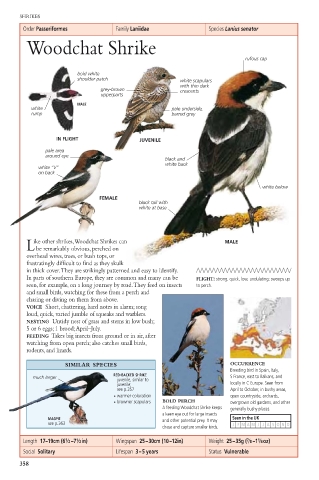
                                                              rufous cap
                    bold white
                    shoulder patch            white scapulars
                                              with thin dark
                          grey-brown          crescents
                          upperparts
                    MALE
         white                              pale underside,
         rump                               barred grey

               IN FLIGHT            JUVENILE
            pale area
            around eye
                                          black and
                                          white back
           white “V”
           on back
                                                                  white below
                          FEMALE
                                    black tail with
                                    white at base


         ike other shrikes,Woodchat Shrikes can          MALE
        Lbe remarkably obvious, perched on
        overhead wires, trees, or bush tops, or
        frustratingly difficult to find as they skulk
        in thick cover.They are strikingly patterned and easy to identify.
        In parts of southern Europe, they are common and many can be  FLIGHT: strong, quick, low, undulating; swoops up
        seen, for example, on a long journey by road.They feed on insects  to perch.
        and small birds, watching for these from a perch and
        chasing or diving on them from above.
        VOICE Short, chattering, hard notes in alarm; song
        loud, quick, varied jumble of squeaks and warblers.
        NESTING Untidy nest of grass and stems in low bush;
        5 or 6 eggs; 1 brood;April–July.
        FEEDING Takes big insects from ground or in air, after
        watching from open perch; also catches small birds,
        rodents, and lizards.
                 SIMILAR SPECIES                          OCCURRENCE
                                                          Breeding bird in Spain, Italy,
                             RED-BACKED SHRIKE
         much larger          juvenile, similar to        S France, east to Balkans, and
                              juvenile;                   locally in C Europe. Seen from
                              see p.357                   April to October, in bushy areas,
                               warmer coloration          open countryside, orchards,
                               browner scapulars  BOLD PERCH  overgrown old gardens, and other
                                         A feeding Woodchat Shrike keeps  generally bushy places.
                                         a keen eye out for large insects
             MAGPIE                      and other potential prey. It may  Seen in the UK
             see p.363                                     JF M A  M J  JA S ON D
                                         chase and capture smaller birds.
       Length  17–19cm (6 1 ⁄2 –7 1 ⁄2in)  Wingspan  25–30cm (10–12in)  Weight  25–35g ( 7 ⁄8 –1 1 ⁄4oz)
       Social  Solitary       Lifespan  3–5 years    Status  Vulnerable
      358

