


Page 367 - Complete Birds of Britain and Europe (DK - RSPB)
P. 367
CROWS
       Order Passeriformes    Family Corvidae        Species Nucifraga caryocatactes
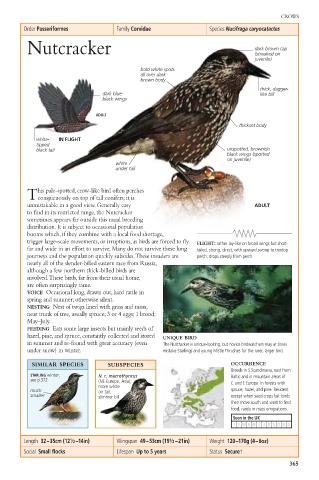
        Nutcracker                                              dark brown cap
                                                                (streaked on
                                                                juvenile)
                                    bold white spots
                                    all over dark
                                    brown body
                                                                  thick, dagger-
                          dark blue-                              like bill
                          black wings
                         ADULT
                                                            thickset body
          white-  IN FLIGHT
          tipped
          black tail                                     unspotted, brownish
                                                         black wings (spotted
                                                         on juvenile)
                              white
                              under tail
          his pale-spotted, crow-like bird often perches
        Tconspicuously on top of tall conifers; it is
        unmistakable in a good view. Generally easy             ADULT
        to find in its restricted range, the Nutcracker
        sometimes appears far outside this usual breeding
        distribution. It is subject to occasional population
        booms which, if they combine with a local food shortage,
        trigger large-scale movements, or irruptions, as birds are forced to fly  FLIGHT: rather Jay-like on broad wings but short-
        far and wide in an effort to survive. Many do not survive these long  tailed, strong, direct, with upward swoop to treetop
        journeys and the population quickly subsides.These invaders are  perch; drops steeply from perch.
        nearly all of the slender-billed eastern race from Russia,
        although a few northern thick-billed birds are
        involved.These birds, far from their usual home,
        are often surprisingly tame.
        VOICE Occasional long, drawn out, hard rattle in
        spring and summer; otherwise silent.
        NESTING Nest of twigs lined with grass and moss,
        near trunk of tree, usually spruce; 3 or 4 eggs; 1 brood;
        May–July.
        FEEDING Eats some large insects but mainly seeds of
        hazel, pine, and spruce, constantly collected and stored  UNIQUE BIRD
        in summer and re-found with great accuracy (even  The Nutcracker is unique-looking, but novice birdwatchers may at times
        under snow) in winter.            mistake Starlings and young Mistle Thrushes for the rarer, larger bird.
         SIMILAR SPECIES    SUBSPECIES                    OCCURRENCE
                                                          Breeds in S Scandinavia, east from
         STARLING winter;  N. c. macrothyncus             Baltic and in mountain areas of
         see p.372       (NE Europe, Asia);               C and E Europe. In forests with
                         more white
         much            on tail;                         spruce, hazel, and pine. Resident
         smaller         slimmer bill                     except when seed crops fail: birds
                                                          then move south and west to find
                                                          food, rarely in mass emigrations.
                                                           Seen in the UK
                                                           JF M A  M J  JA S ON D
       Length  32–35cm (12 1 ⁄2 –14in)  Wingspan  49–53cm (19 1 ⁄2 –21in)  Weight  120–170g (4–6oz)
       Social  Small flocks   Lifespan  Up to 5 years  Status  Secure†
                                                                         365

