


Page 371 - Complete Birds of Britain and Europe (DK - RSPB)
P. 371
CROWS
       Order Passeriformes    Family Corvidae        Species Corvus frugilegus
        Rook                           peaked             bill tapers
                                                          to point
                                       crown
                               glossy black
                   wings more  body
                   pointed than                        bare white skin  face dark
                                                       around bill base
                   Carrion Crow’s                                    at first
        narrow,
        rounded
        tail
                                                                        thin
                                                                        bill

            ADULT
          IN FLIGHT


                            loose, ragged
            rounded         thigh feathers
            tail
                                                            JUVENILE
                                                  ADULT
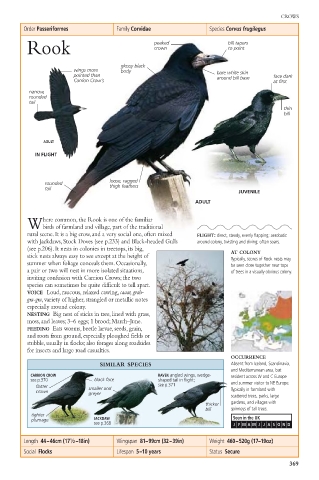
            here common, the Rook is one of the familiar
        Wbirds of farmland and village, part of the traditional
        rural scene. It is a big crow, and a very social one, often mixed   FLIGHT: direct, steady, evenly flapping; aerobatic
        with Jackdaws, Stock Doves (see p.233) and Black-headed Gulls   around colony, twisting and diving; often soars.
        (see p.206). It nests in colonies in treetops, its big,  AT COLONY
        stick nests always easy to see except at the height of  Typically, scores of Rook nests may
        summer when foliage conceals them. Occasionally,  be seen close together near tops
        a pair or two will nest in more isolated situations,  of trees in a visually obvious colony.
        inviting confusion with Carrion Crows; the two
        species can sometimes be quite difficult to tell apart.
        VOICE Loud, raucous, relaxed cawing, caaar, grah-
        gra-gra, variety of higher, strangled or metallic notes
        especially around colony.
        NESTING Big nest of sticks in tree, lined with grass,
        moss, and leaves; 3–6 eggs; 1 brood; March–June.
        FEEDING Eats worms, beetle larvae, seeds, grain,
        and roots from ground, especially ploughed fields or
        stubble, usually in flocks; also forages along roadsides
        for insects and large road casualties.
                                                          OCCURRENCE
                          SIMILAR SPECIES                 Absent from Iceland, Scandinavia,
                                                          and Mediterranean area, but
         CARRION CROW                   RAVEN angled wings, wedge-  resident across W and C Europe
         see p.370      black face      shaped tail in flight;
                                        see p.371         and summer visitor to NE Europe.
          flatter      smaller and                        Typically in farmland with
          crown
                       greyer
                                                          scattered trees, parks, large
                                                    thicker  gardens, and villages with
                                                    bill  spinneys of tall trees.
         tighter                                           Seen in the UK
         plumage        JACKDAW
                        see p.368                          J  F  M  A  M  JJ A S O  N  D
       Length  44–46cm (17 1 ⁄2 –18in)  Wingspan  81–99cm (32–39in)  Weight  460–520g (17–19oz)
       Social  Flocks         Lifespan  5–10 years   Status  Secure
                                                                         369

