


Page 372 - Complete Birds of Britain and Europe (DK - RSPB)
P. 372
CROWS
       Order Passeriformes    Family Corvidae        Species Corvus corone
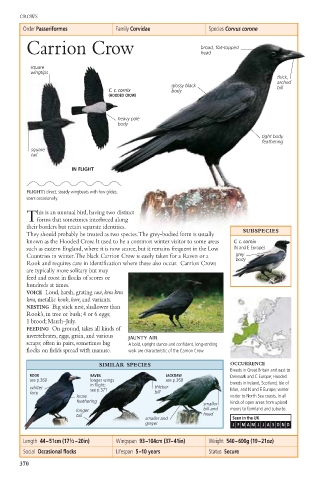
        Carrion Crow                               broad, flat-topped
                                                   head
         square
         wingtips
                                                                      thick,
                                                                      arched
                                            glossy black              bill
                            C. c. cornix    body
                            (HOODED CROW)
                              heavy pale
                              body
                                                                  tight body
                                                                  feathering
         square
         tail
                   IN FLIGHT

        FLIGHT: direct, steady wingbeats with few glides;
        soars occasionally.
          his is an unusual bird, having two distinct
        Tforms that sometimes interbreed along
        their borders but retain separate identities.        SUBSPECIES
        They should probably be treated as two species.The grey-bodied form is usually
        known as the Hooded Crow. It used to be a common winter visitor to some areas  C. c. cornix
        such as eastern England, where it is now scarce, but it remains frequent in the Low  (N and E Europe)
        Countries in winter.The black Carrion Crow is easily taken for a Raven or a  grey
                                                            body
        Rook and requires care in identification where these also occur. Carrion Crows
        are typically more solitary but may
        feed and roost in flocks of scores or
        hundreds at times.
        VOICE Loud, harsh, grating caw, krra krra
        krra, metallic konk, korr, and variants.
        NESTING Big stick nest, shallower than
        Rook’s, in tree or bush; 4 or 6 eggs;
        1 brood; March–July.
        FEEDING On ground, takes all kinds of
        invertebrates, eggs, grain, and various  JAUNTY AIR
        scraps; often in pairs, sometimes big  A bold, upright stance and confident, long-striding
        flocks on fields spread with manure.  walk are characteristic of the Carrion Crow.
                          SIMILAR SPECIES                 OCCURRENCE
                                                          Breeds in Great Britain and east to
        ROOK           RAVEN              JACKDAW         Denmark and C Europe; Hooded
        see p.369      longer wings       see p.368       breeds in Ireland, Scotland, Isle of
                       in flight;
        whiter         see p.371       thicker            Man, and N and E Europe; winter
        face                           bill
                    loose                                 visitor to North Sea coasts. In all
                    feathering                            kinds of open areas from upland
                                                    smaller
                    longer                          bill and  moors to farmland and suburbs.
                    tail                            head
                                     smaller and           Seen in the UK
                                     greyer                J  F  M  A  M  JJ A S O  N  D
       Length  44–51cm (17 1 ⁄2 –20in)  Wingspan  93–104cm (37–41in)  Weight  540–600g (19–21oz)
       Social  Occasional flocks  Lifespan  5–10 years  Status  Secure
      370

