


Page 376 - Complete Birds of Britain and Europe (DK - RSPB)
P. 376
SPARROWS
        Family Passeridae
        SPARROWS

          ELATED MORE CLOSELY to the African  House Sparrows used to gather in hundreds to
        Rweavers than to the similar finches,  feed on grain and weed seeds in winter stubbles,
        sparrows are adaptable and widespread birds, the  but have declined in most places in recent years.
        House Sparrow being closely associated with  Breeding birds may be in loose colonies, using a
        people wherever they are.        variety of sites including the base of White Stork
         Male and female plumages are markedly  nests, thickets, and dense creepers on walls, but
        different in House and Spanish Sparrows, but  House Sparrows mostly occupy holes or cavities
        identical in the Tree Sparrow (both looking more of some sort in roofs and under eaves.Renovation
        like a House Sparrow male). Rock Sparrows, in  of wooden eaves with plastic cladding has often
        another genus altogether, are quite different, but  been blamed for local declines. Even inside a
        have no obvious variations in their plumage.  small cavity, the nest is a mass of grass and other
         All sparrows are social. Spanish Sparrows are  stems,feathers,and scraps,with an overall rounded
        especially gregarious where they are common.  effect that recalls the weavers, but lacking the
                                              neatness and precision of construction
                                              that characterizes their nests. Both House
                                              and Tree Sparrows are suffering a
                                              widespread decline in western Europe.


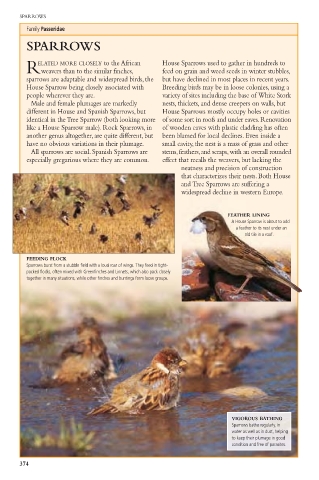
                                                          FEATHER LINING
                                                          A House Sparrow is about to add
                                                            a feather to its nest under an
                                                              old tile in a roof.


        FEEDING FLOCK
        Sparrows burst from a stubble field with a loud roar of wings. They feed in tight-
        packed flocks, often mixed with Greenfinches and Linnets, which also pack closely
        together in many situations, while other finches and buntings form loose groups.


                                                           VIGOROUS BATHING
                                                           Sparrows bathe regularly, in
                                                           water as well as in dust, helping
                                                           to keep their plumage in good
                                                           condition and free of parasites.

      374

