


Page 385 - Complete Birds of Britain and Europe (DK - RSPB)
P. 385
FINCHES
       Order Passeriformes    Family Fringillidae    Species Carduelis flavirostris
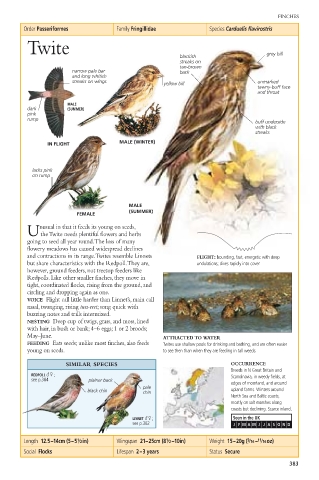
        Twite
                                              blackish             grey bill
                                              streaks on
                                              tan-brown
                   narrow pale bar            back
                   and long whitish
                   streaks on wings                              unmarked
                                          yellow bill
                                                                 tawny-buff face
                                                                 and throat
                  MALE
        dark      (SUMMER)
        pink
        rump
                                                                buff underside
                                                                with black
                                                                streaks
                               MALE (WINTER)
             IN FLIGHT
         lacks pink
         on rump


                                 MALE
                                 (SUMMER)
                    FEMALE
           nusual in that it feeds its young on seeds,
        U the Twite needs plentiful flowers and herbs
        going to seed all year round.The loss of many
        flowery meadows has caused widespread declines
        and contractions in its range.Twites resemble Linnets  FLIGHT: bounding, fast, energetic with deep
        but share characteristics with the Redpoll.They are,  undulations; dives rapidly into cover.
        however, ground feeders, not treetop feeders like
        Redpolls. Like other smaller finches, they move in
        tight, coordinated flocks, rising from the ground, and
        circling and dropping again as one.
        VOICE Flight call little harder than Linnet’s, main call
        nasal, twanging, rising twa-eeet; song quick with
        buzzing notes and trills intermixed.
        NESTING Deep cup of twigs, grass, and moss, lined
        with hair, in bush or bank; 4–6 eggs; 1 or 2 broods;
        May–June.                         ATTRACTED TO WATER
        FEEDING Eats seeds; unlike most finches, also feeds  Twites use shallow pools for drinking and bathing, and are often easier
        young on seeds.                   to see then than when they are feeding in tall weeds.
                 SIMILAR SPECIES                          OCCURRENCE
                                                          Breeds in N Great Britain and
         REDPOLL 32;                                      Scandinavia, in weedy fields, at
         see p.384     plainer back
                                                          edges of moorland, and around
                                     pale
                       black chin    chin                 upland farms. Winters around
                                                          North Sea and Baltic coasts,
                                                          mostly on salt marshes along
                                                          coasts but declining. Scarce inland.
                                  LINNET 32;               Seen in the UK
                                  see p.382                J  F  M  A  M  JJ A S O  N  D
       Length  12.5–14cm (5–5 1 ⁄2in)  Wingspan  21–25cm (8 1 ⁄2 –10in)  Weight  15–20g ( 9 ⁄16 – 11 ⁄16oz)
       Social  Flocks         Lifespan  2–3 years    Status  Secure
                                                                         383

