


Page 380 - Complete Birds of Britain and Europe (DK - RSPB)
P. 380
SPARROWS
       Order Passeriformes    Family Passeridae      Species Petronia petronia
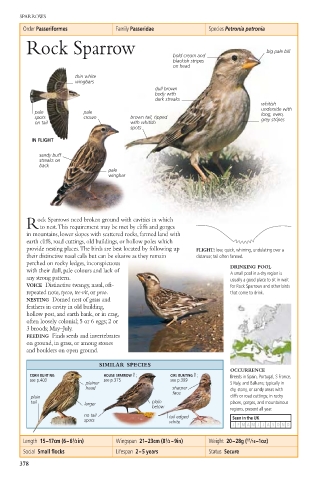
        Rock Sparrow                                               big pale bill
                                            bold cream and
                                            blackish stripes
                                            on head
                    thin white
                    wingbars
                                        dull brown
                                        body with
                                        dark streaks
                                                                  whitish
                                                                  underside with
          pale        pale                                        long, even,
          spots       crown      brown tail, tipped               grey stripes
          on tail                with whitish
                                 spots
         IN FLIGHT
           sandy buff
           streaks on
           back
                            pale
                            wingbar


          ock Sparrows need broken ground with cavities in which
        Rto nest.This requirement may be met by cliffs and gorges
        in mountains, lower slopes with scattered rocks, farmed land with
        earth cliffs, road cuttings, old buildings, or hollow poles which
        provide nesting places.The birds are best located by following up  FLIGHT: low, quick, whirring, undulating over a
        their distinctive nasal calls but can be elusive as they remain  distance; tail often fanned.
        perched on rocky ledges, inconspicuous            DRINKING POOL
        with their dull, pale colours and lack of         A small pool in a dry region is
        any strong pattern.                               usually a good place to sit in wait
        VOICE Distinctive twangy, nasal, oft-             for Rock Sparrows and other birds
        repeated note, tyeoo, tee-vit, or peoo.           that come to drink.
        NESTING Domed nest of grass and
        feathers in cavity in old building,
        hollow post, and earth bank, or in crag,
        often loosely colonial; 5 or 6 eggs; 2 or
        3 broods; May–July.
        FEEDING Finds seeds and invertebrates
        on ground, in grass, or among stones
        and boulders on open ground.
                          SIMILAR SPECIES
                                                          OCCURRENCE
        CORN BUNTING       HOUSE SPARROW 2;  CIRL BUNTING 2;  Breeds in Spain, Portugal, S France,
        see p.403          see p.375       see p.399
                      plainer                             S Italy, and Balkans; typically in
                      head                  sharper       dry, stony, or sandy areas with
                                            face
         plain                                            cliffs or road cuttings; in rocky
         tail         larger           plain              places, gorges, and mountainous
                                       below
                                                          regions, present all year.
                      no tail              tail edged
                      spots                white           Seen in the UK
                                                           JF M A  M J  JA S ON D
       Length  15–17cm (6–6 1 ⁄2in)  Wingspan  21–23cm (8 1 ⁄2 –9in)  Weight  20–28g ( 11 ⁄16–1oz)
       Social  Small flocks   Lifespan  2–5 years    Status  Secure
      378

