


Page 381 - Complete Birds of Britain and Europe (DK - RSPB)
P. 381
FINCHES
        Family Fringillidae
        FINCHES

           HERE ARE TWO MAIN groups of finches, the
        TFringilla species (Chaffinch and Brambling)
        and the Cardueline finches.The Chaffinch
        and Brambling are clearly closely related, their
        different colours arranged in very similar patterns;
        they have the same basic shape and behaviour,
        and frequently mingle in winter.
         The others, however, are a very diverse group.
        Their shapes and behaviour are strongly
        determined by their food.The crossbills have
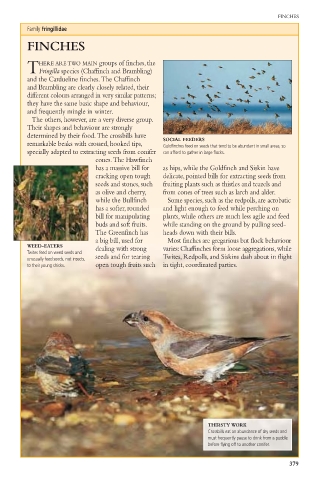
                                          SOCIAL FEEDERS
        remarkable beaks with crossed, hooked tips,  Goldfinches feed on seeds that tend to be abundant in small areas, so
        specially adapted to extracting seeds from conifer  can afford to gather in large flocks.
                         cones.The Hawfinch
                         has a massive bill for  as hips, while the Goldfinch and Siskin have
                         cracking open tough  delicate, pointed bills for extracting seeds from
                         seeds and stones, such  fruiting plants such as thistles and teazels and
                         as olive and cherry,  from cones of trees such as larch and alder.
                         while the Bullfinch  Some species, such as the redpolls, are acrobatic
                         has a softer, rounded  and light enough to feed while perching on
                         bill for manipulating  plants, while others are much less agile and feed
                         buds and soft fruits.  while standing on the ground by pulling seed-
                         The Greenfinch has   heads down with their bills.
                         a big bill, used for  Most finches are gregarious but flock behaviour
        WEED-EATERS      dealing with strong  varies:Chaffinches form loose aggregations,while
        Twites feed on weed seeds and
        unusually feed seeds, not insects,  seeds and for tearing  Twites, Redpolls, and Siskins dash about in flight
        to their young chicks.  open tough fruits such  in tight, coordinated parties.


                                                     THIRSTY WORK
                                                     Crossbills eat an abundance of dry seeds and
                                                     must frequently pause to drink from a puddle
                                                     before flying off to another conifer.

                                                                         379

