


Page 382 - Complete Birds of Britain and Europe (DK - RSPB)
P. 382
FINCHES
       Order Passeriformes    Family Fringillidae    Species Fringilla coelebs
        Chaffinch                                           head with
                                                            ochre-brown
                                                            smudges
                                         blue-grey
                                         head and
                                         bill      dark patch in
        greenish   two white                       front of eye
        rump       wingbars     brown
                                back
                       dark wings
                       with yellowish
                       feather edges
                                                               MALE (WINTER)
        MALE                                       brownish pink
        (SUMMER)                                   cheeks and throat
        IN FLIGHT
                                                              greyish olive from
                                                  white patch  head to back
                                                         duller plumage
                                                         than male’s
                                               pink underside,  but similar
                                               whiter on belly  white bars
                                               and under tail
            dark tail
            with broad
            white sides
              MALE
              (SUMMER)
                                                                   FEMALE
           ne of Europe’s most                            pale greyish
        Oabundant birds, the Chaffinch                    underside
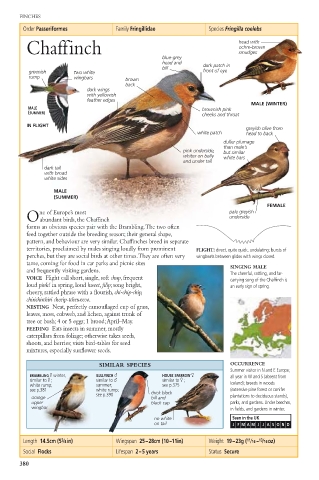
        forms an obvious species pair with the Brambling.The two often
        feed together outside the breeding season; their general shape,
        pattern, and behaviour are very similar. Chaffinches breed in separate
        territories, proclaimed by males singing loudly from prominent  FLIGHT: direct, quite quick, undulating; bursts of
        perches, but they are social birds at other times.They are often very  wingbeats between glides with wings closed.
        tame, coming for food in car parks and picnic sites  SINGING MALE
        and frequently visiting gardens.                  The cheerful, rattling, and far-
        VOICE Flight call short, single, soft chup, frequent  carrying song of the Chaffinch is
        loud pink! in spring, loud hweet, jilip; song bright,  an early sign of spring.
        cheery, rattled phrase with a flourish, chi-chip-chip,
        chirichirchiri cheeip-tcheweeoo.
        NESTING Neat, perfectly camouflaged cup of grass,
        leaves, moss, cobweb, and lichen, against trunk of
        tree or bush; 4 or 5 eggs; 1 brood;April–May.
        FEEDING Eats insects in summer, mostly
        caterpillars from foliage; otherwise takes seeds,
        shoots, and berries; visits bird-tables for seed
        mixtures, especially sunflower seeds.
                          SIMILAR SPECIES                 OCCURRENCE
                                                          Summer visitor in N and E Europe;
        BRAMBLING 2winter,  BULLFINCH 3  HOUSE SPARROW 2  all year in W and S (absent from
        similar to 2;    similar to 3    similar to 2;    Iceland); breeds in woods
        white rump;      summer;         see p.375
        see p.381        white rump;   thick black        (extensive pine forest or conifer
                         see p.390                        plantations to deciduous stands),
         orange                        bill and
         upper                         black cap          parks, and gardens. Under beeches,
         wingbar                                          in fields, and gardens in winter.
                                       no white            Seen in the UK
                                       on tail             J  F  M  A  M  JJ A S O  N  D
       Length  14.5cm (5 3 ⁄4in)  Wingspan  25–28cm (10–11in)  Weight  19–23g ( 11 ⁄16 – 13 ⁄16oz)
       Social  Flocks         Lifespan  2–5 years    Status  Secure
      380

