


Page 412 - Complete Birds of Britain and Europe (DK - RSPB)
P. 412
WILDFOWL
       Family Anatidae  Species Anas discors  Family Anatidae  Species Marmaronetta angustirostris
       Blue-winged Teal                   Marbled Duck

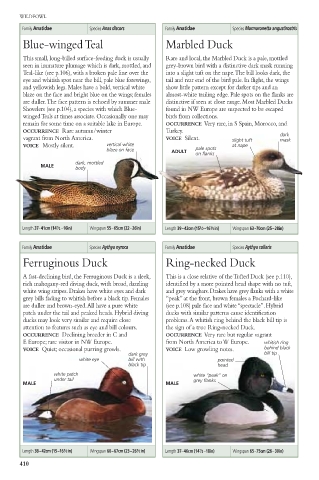
       This small, long-billed surface-feeding duck is usually  Rare and local, the Marbled Duck is a pale, mottled
       seen in immature plumage which is dark, mottled, and  grey-brown bird with a distinctive dark mask running
       Teal-like (see p.106), with a broken pale line over the  into a slight tuft on the nape.The bill looks dark, the
       eye and whitish spot near the bill, pale blue forewings,  tail and rear end of the bird pale. In flight, the wings
       and yellowish legs. Males have a bold, vertical white  show little pattern except for darker tips and an
       blaze on the face and bright blue on the wings; females  almost-white trailing edge. Pale spots on the flanks are
       are duller.The face pattern is echoed by summer male  distinctive if seen at close range. Most Marbled Ducks
       Shovelers (see p.104), a species with which Blue-  found in NW Europe are suspected to be escaped
       winged Teals at times associate. Occasionally one may  birds from collections.
       remain for some time on a suitable lake in Europe.  OCCURRENCE Very rare, in S Spain, Morocco, and
       OCCURRENCE Rare autumn/winter      Turkey.                      dark
       vagrant from North America.        VOICE Silent.    slight tuft  mask
       VOICE Mostly silent.  vertical white                at nape
                           blaze on face    ADULT  pale spots
                                                  on flanks
                    dark, mottled
           MALE     body


       Length 37–41cm (14 1 ⁄2 –16in)  Wingspan 55–65cm (22–26in)  Length 39–42cm (15 1 ⁄2 –16 1 ⁄2in)  Wingspan 63–70cm (25–28in)

       Family Anatidae  Species Aythya nyroca  Family Anatidae  Species Aythya collaris
       Ferruginous Duck                   Ring-necked Duck
       A fast-declining bird, the Ferruginous Duck is a sleek,  This is a close relative of the Tufted Duck (see p.110),
       rich mahogany-red diving duck, with broad, dazzling  identified by a more pointed head shape with no tuft,
       white wing stripes. Drakes have white eyes and dark  and grey wingbars.Drakes have grey flanks with a white
       grey bills fading to whitish before a black tip. Females  “peak” at the front, brown females a Pochard-like
       are duller and brown-eyed.All have a pure white  (see p.108) pale face and white “spectacle”.Hybrid
       patch under the tail and peaked heads. Hybrid diving  ducks with similar patterns cause identification
       ducks may look very similar and require close  problems.A whitish ring behind the black bill tip is
       attention to features such as eye and bill colours.  the sign of a true Ring-necked Duck.
       OCCURRENCE Declining breeder in C and   OCCURRENCE Very rare but regular vagrant
       E Europe; rare visitor in NW Europe.  from North America to W Europe.  whitish ring
       VOICE Quiet; occasional purring growls.  VOICE Low growling notes.  behind black
                                 dark grey                         bill tip
                     white eye   bill with             pointed
                                 black tip             head
              white patch                        white “peak” on
              under tail                         grey flanks
       MALE                               MALE


       Length 38–42cm (15–16 1 ⁄2in)  Wingspan 60–67cm (23–26 1 ⁄2in)  Length 37–46cm (14 1 ⁄2 –18in)  Wingspan 65–75cm (26–30in)
      410

