


Page 415 - Complete Birds of Britain and Europe (DK - RSPB)
P. 415
WILDFOWL/BIRDS OF PREY
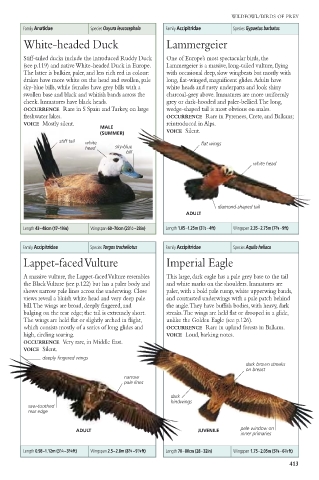
       Family Anatidae  Species Oxyura leucocephala  Family Accipitridae  Species Gypaetus barbatus
       White-headed Duck                  Lammergeier

       Stiff-tailed ducks include the introduced Ruddy Duck  One of Europe’s most spectacular birds, the
       (see p.119) and native White-headed Duck in Europe.  Lammergeier is a massive, long-tailed vulture, flying
       The latter is bulkier, paler, and less rich red in colour:  with occasional deep,slow wingbeats but mostly with
       drakes have more white on the head and swollen, pale  long, flat-winged, magnificent glides.Adults have
       sky-blue bills, while females have grey bills with a  white heads and rusty underparts and look shiny
       swollen base and black and whitish bands across the  charcoal-grey above. Immatures are more uniformly
       cheek. Immatures have black heads.  grey or dark-hooded and paler-bellied.The long,
       OCCURRENCE Rare in S Spain and Turkey, on large  wedge-shaped tail is most obvious on males.
       freshwater lakes.                  OCCURRENCE Rare in Pyrenees, Crete, and Balkans;
       VOICE Mostly silent.               reintroduced in Alps.
                          MALE
                          (SUMMER)        VOICE Silent.
                stiff tail  white                  flat wings
                      head    sky-blue
                                bill
                                                                white head


                                                       diamond-shaped tail
                                               ADULT
       Length 43–48cm (17–19in)  Wingspan 60–70cm (23 1 ⁄2 –28in)  Length 1.05–1.25m (3 1 ⁄2 –4ft)  Wingspan 2.35–2.75m (7 3 ⁄4 –9ft)

       Family Accipitridae  Species Torgos tracheliotus  Family Accipitridae  Species Aquila heliaca
       Lappet-faced Vulture               Imperial Eagle
       A massive vulture, the Lappet-faced Vulture resembles  This large, dark eagle has a pale grey base to the tail
       the Black Vulture (see p.122) but has a paler body and  and white marks on the shoulders. Immatures are
       shows narrow pale lines across the underwing. Close  paler, with a bold pale rump, white upperwing bands,
       views reveal a bluish white head and very deep pale  and contrasted underwings with a pale patch behind
       bill.The wings are broad, deeply fingered, and   the angle.They have buffish bodies, with heavy,dark
       bulging on the rear edge; the tail is extremely short.  streaks.The wings are held flat or drooped in a glide,
       The wings are held flat or slightly arched in flight,  unlike the Golden Eagle (see p.126).
       which consists mostly of a series of long glides and  OCCURRENCE Rare in upland forests in Balkans.
       high, circling soaring.            VOICE Loud, barking notes.
       OCCURRENCE Very rare, in Middle East.
       VOICE Silent.
            deeply fingered wings
                                                              dark brown streaks
                                                              on breast
                                narrow
                                pale lines
                                           dark
                                           hindwings
        saw-toothed
        rear edge
                                                             pale window on
                    ADULT                         JUVENILE
                                                             inner primaries
       Length 0.98–1.12m (3 1 ⁄4 –3 3 ⁄4ft)  Wingspan 2.5–2.8m (8 1 ⁄4 –9 1 ⁄4ft)  Length 70–80cm (28–32in)  Wingspan 1.75–2.05m (5 3 ⁄4 –6 3 ⁄4ft)
                                                                         413

