


Page 413 - Complete Birds of Britain and Europe (DK - RSPB)
P. 413
WILDFOWL
       Family Anatidae  Species Aythya affinis  Family Anatidae  Species Somateria fischeri
       Lesser Scaup                       Spectacled Eider

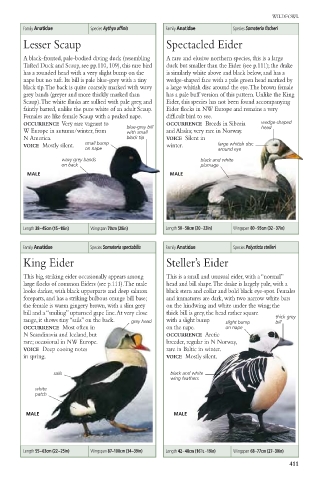
       A black-fronted, pale-bodied diving duck (resembling  A rare and elusive northern species, this is a large
       Tufted Duck and Scaup, see pp.110, 109), this rare bird  duck but smaller than the Eider (see p.111); the drake
       has a rounded head with a very slight bump on the  is similarly white above and black below, and has a
       nape but no tuft. Its bill is pale blue-grey with a tiny  wedge-shaped face with a pale green head marked by
       black tip.The back is quite coarsely marked with wavy  a large whitish disc around the eye.The brown female
       grey bands (greyer and more thickly marked than  has a pale buff version of this pattern. Unlike the King
       Scaup).The white flanks are sullied with pale grey, and  Eider, this species has not been found accompanying
       faintly barred, unlike the pure white of an adult Scaup.  Eider flocks in NW Europe and remains a very
       Females are like female Scaup with a peaked nape.  difficult bird to see.
       OCCURRENCE Very rare vagrant to  blue-grey bill  OCCURRENCE Breeds in Siberia  wedge-shaped
                                                                  head
       W Europe in autumn/winter, from  with small  and Alaska; very rare in Norway.
       N America.               black tip  VOICE Silent in
       VOICE Mostly silent.  small bump   winter.      large whitish disc
                      on nape                          around eye
                wavy grey bands                    black and white
                on back                            plumage
        MALE                               MALE


       Length 38–45cm (15–18in)  Wingspan 70cm (28in)  Length 50–58cm (20–23in)  Wingspan 80–95cm (32–37in)

       Family Anatidae  Species Somateria spectabilis  Family Anatidae  Species Polysticta stelleri
       King Eider                         Steller’s Eider
       This big, striking eider occasionally appears among  This is a small and unusual eider, with a “normal”
       large flocks of common Eiders (see p.111).The male  head and bill shape.The drake is largely pale, with a
       looks darker, with black upperparts and deep salmon  black stern and collar and bold black eye-spot. Females
       foreparts, and has a striking bulbous orange bill base;  and immatures are dark, with two narrow white bars
       the female is warm gingery brown, with a slim grey  on the hindwing and white under the wing; the
       bill and a “smiling” upturned gape line.At very close  thick bill is grey, the head rather square
                                                                     thick grey
       range, it shows tiny “sails” on the back.  grey head  with a slight bump   slight bump  bill
       OCCURRENCE Most often in           on the nape.   on nape
       N Scandinavia and Iceland, but     OCCURRENCE Arctic
       rare; occasional in NW Europe.     breeder, regular in N Norway,
       VOICE Deep cooing notes            rare in Baltic in winter.
       in spring.                         VOICE Mostly silent.

              sails                        black and white
                                           wing feathers
          white
          patch

        MALE                                MALE


       Length 55–63cm (22–25in)  Wingspan 87–100cm (34–39in)  Length 42–48cm (16 1 ⁄2 –19in)  Wingspan 68–77cm (27–30in)
                                                                         411

