


Page 408 - Complete Birds of Britain and Europe (DK - RSPB)
P. 408
SHEARWATERS AND PETRELS/CORMORANTS AND PELICANS
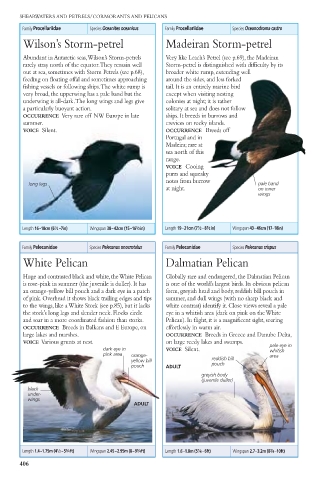
       Family Procellariidae  Species Oceanites oceanicus  Family Procellariidae  Species Oceanodroma castro
       Wilson’s Storm-petrel              Madeiran Storm-petrel
       Abundant in Antarctic seas,Wilson’s Storm-petrels  Very like Leach’s Petrel (see p.69), the Madeiran
       rarely stray north of the equator.They remain well   Storm-petrel is distinguished with difficulty by its
       out at sea, sometimes with Storm Petrels (see p.68),  broader white rump, extending well
       feeding on floating offal and sometimes approaching  around the sides, and less forked
       fishing vessels or following ships.The white rump is  tail. It is an entirely marine bird
       very broad, the upperwing has a pale band but the  except when visiting nesting
       underwing is all-dark.The long wings and legs give   colonies at night; it is rather
       a particularly buoyant action.     solitary at sea and does not follow
       OCCURRENCE Very rare off NW Europe in late  ships. It breeds in burrows and
       summer.                            crevices on rocky islands.
       VOICE Silent.                      OCCURRENCE Breeds off
                                          Portugal and in
                                          Madeira; rare at
                                          sea north of this
                                          range.
                                          VOICE Cooing
                                          purrs and squeaky
                                          notes from burrow
        long legs                                                pale band
                                          at night.              on inner
                                                                 wings


       Length 16–18cm (6 1 ⁄2 –7in)  Wingspan 38–42cm (15–16 1 ⁄2in)  Length 19–21cm (7 1 ⁄2 –8 1 ⁄2in)  Wingspan 43–46cm (17–18in)

       Family Pelecanidae  Species Pelecanus onocrotalus  Family Pelecanidae  Species Pelecanus crispus
       White Pelican                      Dalmatian Pelican
       Huge and contrasted black and white,the White Pelican  Globally rare and endangered, the Dalmatian Pelican
       is rose-pink in summer (the juvenile is duller). It has  is one of the world’s largest birds. Its obvious pelican
       an orange-yellow bill pouch and a dark eye in a patch  form, greyish head and body, reddish bill pouch in
       of pink. Overhead it shows black trailing edges and tips  summer, and dull wings (with no sharp black and
       to the wings, like a White Stork (see p.85), but it lacks  white contrast) identify it. Close views reveal a pale
       the stork’s long legs and slender neck. Flocks circle  eye in a whitish area (dark on pink on the White
       and soar in a more coordinated fashion than storks.  Pelican). In flight, it is a magnificent sight, soaring
       OCCURRENCE Breeds in Balkans and E Europe, on  effortlessly in warm air.
       large lakes and marshes.           OCCURRENCE Breeds in Greece and Danube Delta,
       VOICE Various grunts at nest.      on large reedy lakes and swamps.
                                                                    pale eye in
                           dark eye in    VOICE Silent.             whitish
                           pink area  orange-                       area
                                  yellow bill         reddish bill
                                  pouch   ADULT       pouch
                                                   greyish body
                                                   (juvenile duller)
        black
        under-
        wings
                                  ADULT


       Length 1.4–1.75m (4 1 ⁄2 –5 3 ⁄4ft)  Wingspan 2.45–2.95m (8–9 3 ⁄4ft)  Length 1.6–1.8m (5 1 ⁄4 –6ft)  Wingspan 2.7–3.2m (8 3 ⁄4 –10ft)
      406

