


Page 61 - Complete Birds of Britain and Europe (DK - RSPB)
P. 61
DIVERS AND GREBES
       Order Podicipediformes  Family Podicipedidae  Species Tachybaptus ruficollis
        Little Grebe

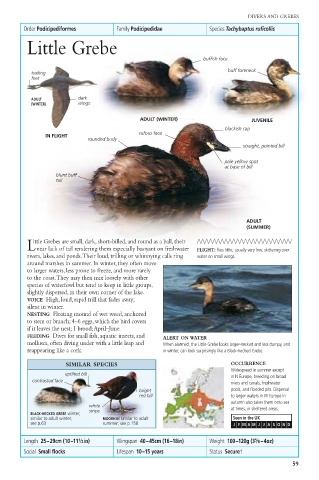
                                                   buffish face
                                                          buff foreneck
         trailing
         feet
         ADULT      dark
         (WINTER)   wings
                                    ADULT (WINTER)             JUVENILE
                                                         blackish cap
                                    rufous face
            IN FLIGHT
                       rounded body
                                                             straight, pointed bill
                                                         pale yellow spot
                                                         at base of bill
               blunt buff
               tail


                                                              ADULT
                                                              (SUMMER)
         ittle Grebes are small, dark, short-billed, and round as a ball, their
        Lnear lack of tail rendering them especially buoyant on freshwater  FLIGHT: flies little, usually very low, skittering over
        rivers, lakes, and ponds.Their loud, trilling or whinnying calls ring  water on small wings.
        around marshes in summer. In winter, they often move
        to larger waters, less prone to freeze, and more rarely
        to the coast.They may then mix loosely with other
        species of waterfowl but tend to keep in little groups,
        slightly dispersed, in their own corner of the lake.
        VOICE High, loud, rapid trill that fades away;
        silent in winter.
        NESTING Floating mound of wet weed, anchored
        to stem or branch; 4–6 eggs, which the bird covers
        if it leaves the nest; 1 brood;April–June.
        FEEDING Dives for small fish, aquatic insects, and  ALERT ON WATER
        molluscs, often diving under with a little leap and  When alarmed, the Little Grebe looks larger-necked and less dumpy, and
        reappearing like a cork.          in winter, can look surprisingly like a Black-necked Grebe.
                 SIMILAR SPECIES                          OCCURRENCE
                                                          Widespread in summer except
                 uptilted bill
                                                          in N Europe, breeding on broad
         contrasted face
                                                          rivers and canals, freshwater
                                    bright                pools, and flooded pits. Dispersal
                                    red bill              to larger waters in W Europe in
                                                          autumn also takes them onto sea
                       white                              at times, in sheltered areas.
                       stripe
         BLACK-NECKED GREBE winter,
         similar to adult winter;   MOORHEN similar to adult  Seen in the UK
         see p.63          summer; see p.158               J  F  M  A  M  JJ A S O  N  D
       Length  25–29cm (10–11 1 ⁄2in)  Wingspan  40–45cm (16–18in)  Weight  100–120g (3 5 ⁄8 –4oz)
       Social  Small flocks   Lifespan  10–15 years  Status  Secure†
                                                                          59

