


Page 63 - Complete Birds of Britain and Europe (DK - RSPB)
P. 63
DIVERS AND GREBES
       Order Podicipediformes  Family Podicipedidae  Species Podiceps cristatus
        Great Crested Grebe                                    black head plumes


                                           white face
                        drooping neck
                                          unique ruff
         legs                                                      dagger-like
         below       bold white                                    pink bill
         body level  wing patches              slender
                                dull, dark
                                back           neck
                  ADULT
                  (WINTER)
                                                                white neck
                                                                and breast
            IN FLIGHT
               ADULT
               (SUMMER)
                                                                    white over
                                                                    eye
                     striped
                     head
           pale greyish
           body
                                                                      pink bill
                                           tailless  dark back
                                           shape                    white
                                                                    breast
                                JUVENILE
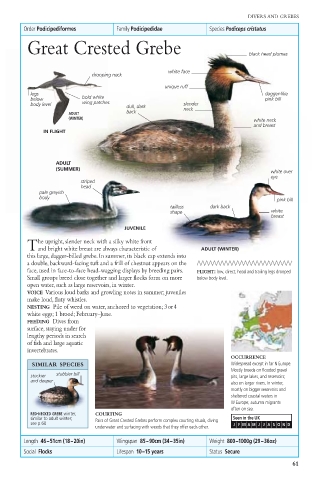
          he upright, slender neck with a silky white front
        Tand bright white breast are always characteristic of  ADULT (WINTER)
        this large, dagger-billed grebe. In summer, its black cap extends into
        a double, backward-facing tuft and a frill of chestnut appears on the
        face, used in face-to-face head-wagging displays by breeding pairs.  FLIGHT: low, direct; head and trailing legs drooped
        Small groups breed close together and larger flocks form on more  below body level.
        open water, such as large reservoirs, in winter.
        VOICE Various loud barks and growling notes in summer; juveniles
        make loud, fluty whistles.
        NESTING Pile of weed on water, anchored to vegetation; 3or4
        white eggs; 1 brood; February–June.
        FEEDING Dives from
        surface, staying under for
        lengthy periods in search
        of fish and large aquatic
        invertebrates.
                                                          OCCURRENCE
         SIMILAR SPECIES                                  Widespread except in far N Europe.
                                                          Mostly breeds on flooded gravel
         stockier   stubbier bill                         pits, large lakes, and reservoirs;
         and deeper
                                                          also on larger rivers. In winter,
                                                          mostly on bigger reservoirs and
                                                          sheltered coastal waters in
                                                          W Europe; autumn migrants
                                                          often on sea.
         RED-NECKED GREBE winter,  COURTING
         similar to adult winter;   Pairs of Great Crested Grebes perform complex courting rituals, diving  Seen in the UK
         see p.60                                          J  F  M  A  M  JJ A S O  N  D
                         underwater and surfacing with weeds that they offer each other.
       Length  46–51cm (18–20in)  Wingspan  85–90cm (34–35in)  Weight  800–1000g (29–36oz)
       Social  Flocks         Lifespan  10–15 years  Status  Secure
                                                                          61

