


Page 66 - Complete Birds of Britain and Europe (DK - RSPB)
P. 66
PETRELS AND SHEARWATERS
        Families Procellariidae, Hydrobatidae
        PETRELS AND SHEARWATERS

          O SUPREMELY ADAPTED to life at sea that  SHEARWATERS
        Sthey are cumbersome and vulnerable on land, Superb fliers, using air currents over the waves,
        petrels and shearwaters (with the exception of the shearwaters are almost helpless ashore and in
        cliff-nesting Fulmar) come to land only to breed  danger from predatory gulls and skuas when
        and then do so only under the cover of darkness. returning to their colonies.They fly with stiffly
        By far the best chance of seeing most of them is  outstretched wings and long glides between brief
        from a ship at sea.              periods of wingbeats. In still air, they look rather
                                         heavy but with a wind become wonderfully
        PETRELS                          capable, banking steeply over onto one wingtip
        Like shearwaters and albatrosses, petrels’ tubular  then to the other,showing alternately dark
        nostrils excrete excess salt, and these birds are  upperparts and light underparts as they fly past
        known collectively as “tubenoses”.They breed  far offshore.Young birds may be exhausted and
        in burrows or cavities, staying out of sight all day.  blown inland by autumn gales.
        Returning birds follow calls from their mates on
        the nests and use scent to find the right burrow      GREAT
        in pitch dark.                                        SHEARWATER
                                                              An ocean-going migrant,
         Petrels are mostly small and insignificant over      this species breeds in the
        the open sea, but are dainty fliers, coping with      northern winter on islands
        the most ferocious gales as they skim the wave        in the South Atlantic.
        crests.They are sometimes driven close inshore
        and may then find it difficult to get back out
        to sea, sometimes ending up, exhausted, inland.
        Several species, especially the Storm Petrel,
        follow ships to feed on organisms that are
        disturbed in the wake.
         The Fulmar is a larger bird, easily seen on its
        open cliff ledge nest or flying beside cliff tops
        during the day.


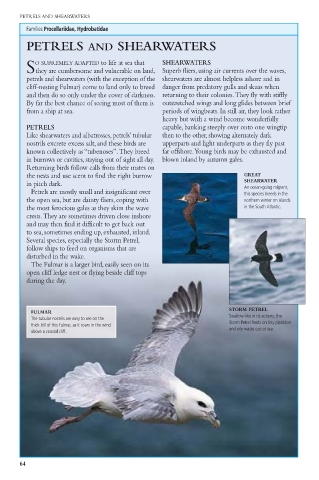
                                                          STORM PETREL
         FULMAR
         The tubular nostrils are easy to see on the      Swallow-like in its actions, the
         thick bill of this Fulmar, as it soars in the wind  Storm Petrel feeds on tiny plankton
         above a coastal cliff.                           and oily waste out at sea.


      64

