


Page 97 - Complete Birds of Britain and Europe (DK - RSPB)
P. 97
WILDFOWL
       Order Anseriformes     Family Anatidae        Species Anser brachyrhynchus
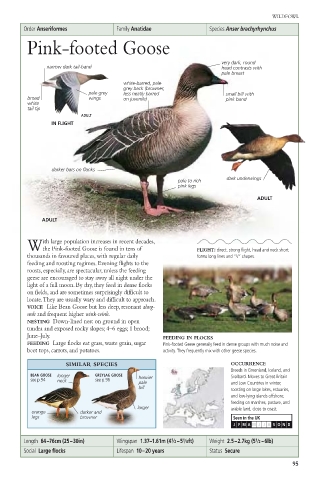
        Pink-footed Goose

                                                        very dark, round
             narrow dark tail-band                      head contrasts with
                                                        pale breast
                                white-barred, pale
                                grey back (browner,
                       pale grey  less neatly barred     small bill with
        broad          wings    on juvenile)             pink band
        white
        tail tip
                     ADULT
              IN FLIGHT


              darker bars on flanks
                                             pale to rich  dark underwings
                                             pink legs
                                                                 ADULT


           ADULT

            ith large population increases in recent decades,
        Wthe Pink-footed Goose is found in tens of  FLIGHT: direct, strong flight, head and neck short;
        thousands in favoured places, with regular daily  forms long lines and “V” shapes.
        feeding and roosting regimes. Evening flights to the
        roosts, especially, are spectacular, unless the feeding
        geese are encouraged to stay away all night under the
        light of a full moon. By day, they feed in dense flocks
        on fields, and are sometimes surprisingly difficult to
        locate.They are usually wary and difficult to approach.
        VOICE Like Bean Goose but less deep, resonant ahng-
        unk and frequent higher wink-wink.
        NESTING Down-lined nest on ground in open
        tundra and exposed rocky slopes; 4–6 eggs; 1 brood;
        June–July.                        FEEDING IN FLOCKS
        FEEDING Large flocks eat grass, waste grain, sugar  Pink-footed Geese generally feed in dense groups with much noise and
        beet tops, carrots, and potatoes.  activity. They frequently mix with other geese species.
                 SIMILAR SPECIES                          OCCURRENCE
                                                          Breeds in Greenland, Iceland, and
         BEAN GOOSE  longer  GREYLAG GOOSE  heavier       Svalbard. Moves to Great Britain
         see p.94  neck  see p.96  pale                   and Low Countries in winter,
                                   bill
                                                          roosting on large lakes, estuaries,
                                                          and low-lying islands offshore;
                                                          feeding on marshes, pasture, and
                                   larger                 arable land, close to coast.
         orange      darker and
         legs        browner                               Seen in the UK
                                                           JF M A  M J  JA S ON D
       Length  64–76cm (25–30in)  Wingspan  1.37–1.61m (4 1 ⁄2 –5 1 ⁄4ft)  Weight  2.5–2.7kg (5 1 ⁄2 –6lb)
       Social  Large flocks   Lifespan  10–20 years  Status  Secure
                                                                          95

