


Page 92 - Complete Birds of Britain and Europe (DK - RSPB)
P. 92
WILDFOWL
       Order Anseriformes     Family Anatidae        Species Cygnus olor
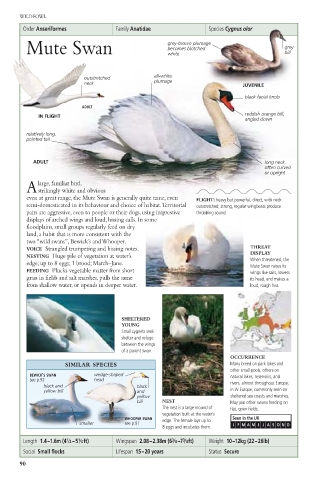
        Mute Swan                          grey-brown plumage           grey
                                           becomes blotched
                                                                        bill
                                           white

                      outstretched     all-white
                      neck             plumage
                                                             JUVENILE
                                                              black facial knob
                     ADULT
                                                              reddish orange bill,
           IN FLIGHT
                                                              angled down
        relatively long,
        pointed tail


         ADULT                                                     long neck,
                                                                   often curved
                                                                   or upright
          large, familiar bird,
        A strikingly white and obvious
        even at great range, the Mute Swan is generally quite tame, even  FLIGHT: heavy but powerful, direct, with neck
        semi-domesticated in its behaviour and choice of habitat.Territorial  outstretched; strong, regular wingbeats produce
        pairs are aggressive, even to people or their dogs, using impressive  throbbing sound.
        displays of arched wings and loud, hissing calls. In some
        floodplains, small groups regularly feed on dry
        land, a habit that is more consistent with the
        two “wild swans”, Bewick’s and Whooper.
        VOICE Strangled trumpeting and hissing notes.          THREAT
        NESTING Huge pile of vegetation at water’s             DISPLAY
                                                               When threatened, the
        edge; up to 8 eggs; 1 brood; March–June.               Mute Swan raises its
        FEEDING Plucks vegetable matter from short             wings like sails, lowers
        grass in fields and salt marshes, pulls the same       its head, and makes a
        from shallow water, or upends in deeper water.         loud, rough hiss.


                               SHELTERED
                               YOUNG
                               Small cygnets seek
                               shelter and refuge
                               between the wings
                               of a parent swan.
                                                          OCCURRENCE
                 SIMILAR SPECIES                          Many breed on park lakes and
                                                          other small pools, others on
        BEWICK’SSWAN    wedge-shaped                      natural lakes, reservoirs, and
        see p.92        head                              rivers, almost throughout Europe;
            black and              black
            yellow bill            and                    in W Europe, commonly seen on
                                   yellow                 sheltered sea coasts and marshes.
                                   bill  NEST             May join other swans feeding on
                                         The nest is a large mound of  flat, open fields.
                                         vegetation built at the water’s
                                WHOOPER SWAN  edge. The female lays up to   Seen in the UK
                     smaller    see p.91                   J  F  M  A  M  JJ A S O  N  D
                                         8 eggs and incubates them.
       Length  1.4–1.6m (4 1 ⁄2 –5 1 ⁄4ft)  Wingspan  2.08–2.38m (6 3 ⁄4 –7 3 ⁄4ft)  Weight  10–12kg (22–26lb)
       Social  Small flocks   Lifespan  15–20 years  Status  Secure
      90

