


Page 102 - Complete Birds of Britain and Europe (DK - RSPB)
P. 102
WILDFOWL
       Order Anseriformes     Family Anatidae        Species Tadorna tadorna
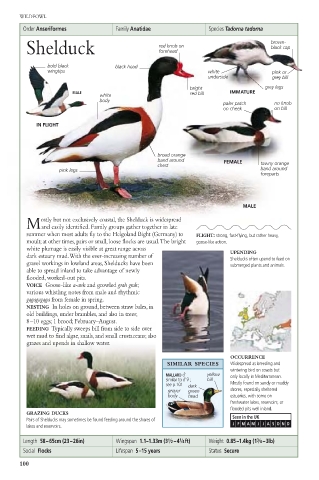
        Shelduck                        red knob on                 brown-
                                                                    black cap
                                        forehead
             bold black       black head
             wingtips                                white           pink or
                                                     underside       grey bill
                                                bright             grey legs
                   MALE                         red bill  IMMATURE
                          white
                          body
                                                        paler patch  no knob
                                                        on cheek     on bill
          IN FLIGHT


                                        broad orange
                                        band around      FEMALE
                                        chest                     tawny orange
                pink legs                                         band around
                                                                  foreparts


                                                             MALE
           ostly but not exclusively coastal, the Shelduck is widespread
        Mand easily identified. Family groups gather together in late
        summer when most adults fly to the Helgoland Bight (Germany) to  FLIGHT: strong, fast-flying, but rather heavy,
        moult;at other times,pairs or small,loose flocks are usual.The bright  goose-like action.
        white plumage is easily visible at great range across  UPENDING
        dark estuary mud.With the ever-increasing number of  Shelducks often upend to feed on
        gravel workings in lowland areas, Shelducks have been  submerged plants and animals.
        able to spread inland to take advantage of newly
        flooded, worked-out pits.
        VOICE Goose-like a-ank and growled grah grah;
        various whistling notes from male and rhythmic
        gagagagaga from female in spring.
        NESTING In holes on ground, between straw bales, in
        old buildings, under brambles, and also in trees;
        8–10 eggs; 1 brood; February–August.
        FEEDING Typically sweeps bill from side to side over
        wet mud to find algae, snails, and small crustaceans; also
        grazes and upends in shallow water.
                                                          OCCURRENCE
                                           SIMILAR SPECIES  Widespread as breeding and
                                                          wintering bird on coasts but
                                          MALLARD 3  yellow  only locally in Mediterranean.
                                          similar to 32;  bill
                                          see p.101  dark  Mostly found on sandy or muddy
                                           greyer  green  shores, especially sheltered
                                           body  head     estuaries, with some on
                                                          freshwater lakes, reservoirs, or
                                                          flooded pits well inland.
        GRAZING DUCKS
                                                           Seen in the UK
        Pairs of Shelducks may sometimes be found feeding around the shores of
                                                           J  F  M  A  M  JJ A S O  N  D
        lakes and reservoirs.
       Length  58–65cm (23–26in)  Wingspan  1.1–1.33m (3 1 ⁄2 –4 1 ⁄4ft)  Weight  0.85–1.4kg (1 3 ⁄4 –3lb)
       Social  Flocks         Lifespan  5–15 years   Status  Secure
      100

