


Page 24 - All About History - Issue 29-15
P. 24
USA


         Day in the life


        APILGRIMFATHER


         EARLY PIONEERS MAKING A FRESH

         START IN THE NEW WORLD, PLYMOUTH

         COLONY, UNITED STATES, 17TH CENTURY


             The Plymouth Colony was not the first English colonial venture in
             North America, and it certainly wasn’t the most successful, but to this
             day it occupies a special part of American history. What made the
             colony different is that instead of the entrepreneurs that wished
             to make their fortune in colonies like Jamestown, the Plymouth
             settlers were fleeing religious persecution in England, seeking
             a place they could be free to practise their faith. They made
             the dangerous voyage from Plymouth, England, to North
             America, but once they stepped foot on land, they
             faced a difficult and dangerous struggle to
             create the home they dreamed of.
                BUILD LODGINGS


                Once ashore, the colony decided to settle in a
                village that was previously abandoned due to a
                plague. Thanks to this outbreak, the colonists faced
                no resistance from the weakened natives when
                settling and constructing their houses. In order to
                reduce the number of houses needed, single men
                lived with families in a plot one-half rod wide and
                three rods long for each household member.
                NEGOTIATE WITH LOCALS


                The Plymouth fathers had a tumultuous
                relationship with the native tribes. The pilgrims
                initially received a hostile welcome from natives
                with previously bad experiences of Englishmen.
                However, a Native American that spoke some
                English named Samoset made contact with the
                colonists. Through Samoset they met the chief
                of the tribe – Massasoit – and also Squanto, who
                would prove indispensable to their survival. The
                Native Americans and pilgrims were both eager
                for mutual peace and established a trading pact.

                WORK ON THE FARM

                Each colonist received 100 acres of land, and
                there was a further 1,500 acres for common
                use. These small family farms helped maintain
                the economy. The settlers learned many farming
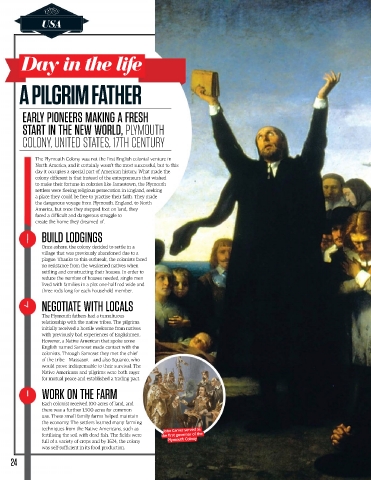
                techniques from the Native Americans, such as   John Carver served as
                fertilising the soil with dead fish. The fields were  the first governor of the
                full of a variety of crops and by 1624, the colony   Plymouth Colony
                was self-sufficient in its food production.
     24

