


Page 29 - All About History - Issue 29-15
P. 29
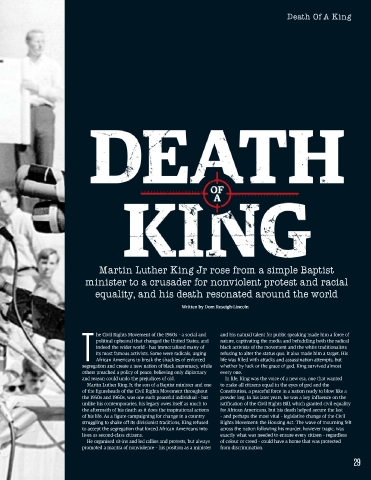
Death Of A King


                                    MartinLutherKingJrrosefromasimpleBaptist

                               minister to a crusader for nonviolent protest and racial

                                  equality, and his death resonated around the world

                                                                 Written by Dom Reseigh-Lincoln


                                   he Civil Rights Movement of the 1960s – a social and   and his natural talent for public speaking made him a force of
                                   political upheaval that changed the United States, and   nature, captivating the media and befuddling both the radical
                                   indeed the wider world – has immortalised many of   black activists of the movement and the white traditionalists
                                   its most famous activists. Some were radicals, urging   refusing to alter the status quo. It also made him a target. His
                              T African Americans to break the shackles of enforced   life was filled with attacks and assassination attempts, but
                              segregation and create a new nation of black supremacy, while   whether by luck or the grace of god, King survived almost
                              others preached a policy of peace, believing only diplomacy   every one.
                              and reason could undo the prejudices of old.      In life, King was the voice of a new era, one that wanted
                                Martin Luther King Jr, the son of a Baptist minister and one   to make all citizens equal in the eyes of god and the
                              of the figureheads of the Civil Rights Movement throughout   Constitution, a peaceful force in a nation ready to blow like a
                              the 1950s and 1960s, was one such peaceful individual – but   powder keg. In his later years, he was a key influence on the
                              unlike his contemporaries, his legacy owes itself as much to   ratification of the Civil Rights Bill, which granted civil equality
                              the aftermath of his death as it does the inspirational actions   for African Americans, but his death helped secure the last
                              of his life. As a figure campaigning for change in a country   – and perhaps the most vital – legislative change of the Civil
                              struggling to shake off its divisionist traditions, King refused   Rights Movement: the Housing Act. The wave of mourning felt
                              to accept the segregation that forced African Americans into   across the nation following his murder, however tragic, was
                              lives as second-class citizens.                 exactly what was needed to ensure every citizen – regardless
                                He organised sit-ins and led rallies and protests, but always   of colour or creed – could have a home that was protected
                              promoted a mantra of nonviolence – his position as a minister   from discrimination.
                                                                                                                             29

