


Page 25 - All About History - Issue 29-15
P. 25
USA
TRADE FURS
The fur trade was the main source of income for
the colony. The colonists would buy their furs
from Native Americans and then sell them on to
Europeans. They created trading posts throughout
the region, even as far as Maine. The importance of
the income the trade provided was made evident
when it was disrupted by a violent skirmish, and
the colony’s economy suffered as a result.
COLLECTIVE WORSHIP
The absolute focus of the Plymouth colony was
to create a place free from religious persecution,
and much of the settler’s lives revolved around
worship. Attendance to church was mandatory for
all, but people could only become a member if they
professed their faith. However, anyone who flouted
religious rules could receive a formal warning and
even excommunication. The church personally
dealt with any law breakers – punishing a wide
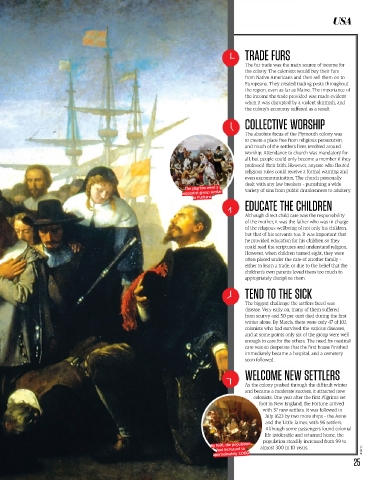
The pilgrims were a
separatist group similar variety of sins from public drunkenness to adultery.
to Puritans
EDUCATE THE CHILDREN
Although direct child care was the responsibility
of the mother, it was the father who was in charge
of the religious wellbeing of not only his children,
but that of his servants too. It was important that
he provided education for his children so they
could read the scriptures and understand religion.
However, when children turned eight, they were
often placed under the care of another family –
either to learn a trade, or due to the belief that the
children’s own parents loved them too much to
appropriately discipline them.
TEND TO THE SICK
The biggest challenge the settlers faced was
disease. Very early on, many of them suffered
from scurvy and 50 per cent died during the first
winter alone. By March, there were only 47 of 102
colonists who had survived the various diseases,
and at some points only six of the group were well
enough to care for the others. The need for medical
care was so desperate that the first house finished
immediately became a hospital, and a cemetery
soon followed.
WELCOME NEW SETTLERS
As the colony pushed through the difficult winter
and became a moderate success, it attracted new
colonists. One year after the first Pilgrims set
foot in New England, the Fortune arrived
with 37 new settlers. It was followed in
July 1623 by two more ships – the Anne
and the Little James, with 96 settlers.
Although some passengers found colonial
life intolerable and returned home, the
population steadily increased from 99 to
By 1691, the population
had increased to almost 300 in 10 years. © Alamy
approximately 7,000
25

