


Page 137 - (DK Eyewitness) Travel Guide - Spain
P. 137
BASQUE C OUNTR Y , NA V ARR A & LA RIOJA 135
jumble of steep, nar row streets
and little squares, churches and
the Monasterio de Santa Clara,
begun in the 13th century. The
houses along the Rúa Cerco de
Fuera and the Rúa Mayor were
built between the 16th and
18th centuries.
The castle, the Palacio Real
de Olite, was built in the early
15th century by Carlos III, and
has earned Olite its nickname
“the Gothic town”. It was heavily
fortified, but was brilliantly
decorated inside by Mudéjar
artists with azulejos (ceramic
tiles) and marquetry ceilings.
The walkways were planted with
vines and orange trees, and there
was an aviary and a lions’ den.
During the War of Indepen-
dence (see pp66–7) the castle
was burned to prevent it fall ing
into French hands. Since 1937,
however, it has been restored to a
semblance of its former glory. Part
of it houses a parador (see p564).
Today, the castle is a com plex
of courtyards, passages, large
halls, royal chambers, battle-
ments and turrets. From the
“windy tower”, monarchs
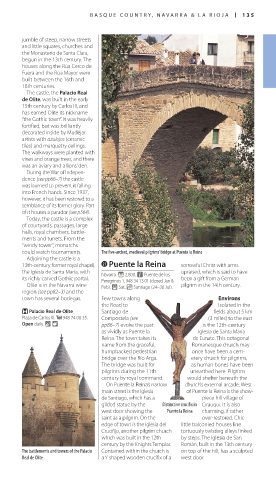
could watch tournaments. The five-arched, medieval pilgrims’ bridge at Puente la Reina
Adjoining the castle is a
13th-century former royal chapel, a Puente la Reina sorrowful Christ with arms
the Iglesia de Santa María, with Navarra. * 2,800. n Puente de los upraised, which is said to have
its richly carved Gothic portal. Peregrinos 1, 948 34 13 01 (closed Jan & been a gift from a German
Olite is in the Navarra wine Feb). ( Sat. _ Santiago (24–30 Jul). pilgrim in the 14th century.
region (see pp82–3) and the
town has several bodegas. Few towns along Environs
the Road to Isolated in the
+ Palacio Real de Olite Santiago de fields about 5 km
Plaza de Carlos III. Tel 948 74 00 35. Compostela (see (3 miles) to the east
Open daily. & 8 pp86–7) evoke the past is the 12th-century
as vividly as Puente la Iglesia de Santa María
Reina. The town takes its de Eunate. This octagonal
name from the graceful, Romanesque church may
humpbacked pedestrian once have been a cem-
bridge over the Río Arga. etery church for pilgrims,
The bridge was built for as human bones have been
pil grims during the 11th unearthed here. Pil grims
century by royal command. would shelter beneath the
On Puente la Reina’s nar row church’s external arcade. West
main street is the Iglesia of Puente la Reina is the show-
de Santiago, which has a piece hill village of
gilded statue by the Distinctive crucifix in Cirauqui. It is also
west door showing the Puente la Reina charming, if rather
saint as a pilgrim. On the over-restored. Chic
edge of town is the Iglesia del little balconied houses line
Crucifijo, another pilgrim church tortuously twisting alleys linked
which was built in the 12th by steps. The Iglesia de San
century by the Knights Templar. Román, built in the 13th century
The battlements and towers of the Palacio Con tained within the church is on top of the hill, has a sculpted
Real de Olite a Y-shaped wooden crucifix of a west door.
134-135_EW_Spain.indd 135 26/09/17 11:00 am

